


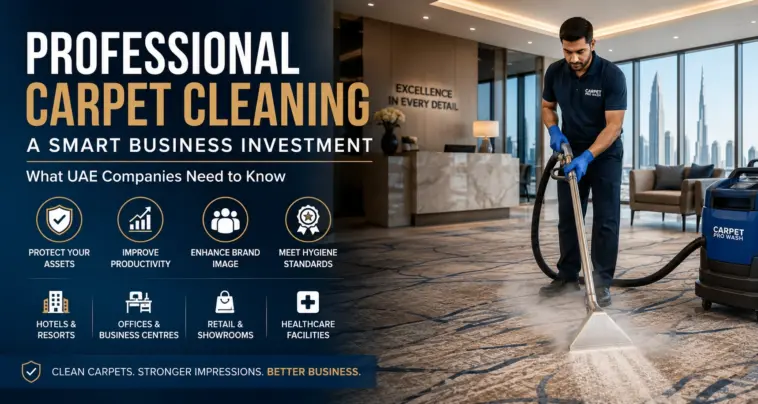
In business, first impressions are currency. Before a client hears your pitch, before a customer reads your menu, before a guest checks into their room — they have already formed an opinion based on the environment around them. Floors and carpets, covering more surface area than any other interior element, contribute more to that first impression than most business owners realize.
For companies operating across the UAE — whether a hotel in Dubai Marina, a corporate office in DIFC, a retail showroom in Business Bay, or a healthcare facility in Dubai Healthcare City — maintaining clean, well-presented carpets is not just a hygiene consideration. It is a direct reflection of brand standards, and a measurable factor in employee productivity, customer retention, and asset longevity. That is precisely why professional cleaning carpet services have become a standard operating line item for businesses that take their brand and their workspace seriously.
The Real Business Cost of Neglected Carpets
Asset Depreciation
Commercial carpets represent a significant capital investment. High-quality carpet for a medium-sized office or hotel floor can run into tens of thousands of dirhams. Without proper maintenance, that investment degrades rapidly — fibers break down under accumulated grit and soil, colors fade, and what was once a premium finish begins to look tired and worn.
The math is straightforward: regular professional cleaning extends carpet life by years. Delaying cleaning to save cost in the short term almost always results in far higher replacement costs in the medium term.
Brand Perception and Customer Experience
Research across hospitality, retail, and professional services consistently finds that physical environment quality is among the top factors influencing customer satisfaction and repeat business. A worn, stained, or odorous carpet in a hotel lobby, restaurant, or office reception area communicates neglect — regardless of how strong the core product or service is.
For businesses in the UAE’s competitive hospitality and retail sectors, where customer expectations are exceptionally high, this is not a minor consideration. It is a brand risk.
Employee Productivity and Wellbeing
Indoor air quality in commercial environments is directly affected by carpet cleanliness. Carpets in high-traffic offices accumulate dust, allergens, bacteria, and particulate matter that are continuously redistributed into the breathing environment. Studies have linked poor indoor air quality to increased absenteeism, reduced concentration, and lower overall staff productivity.
Maintaining clean carpets is, in this sense, an investment in your workforce — not just your premises.
Why Commercial Carpet Cleaning Differs From Residential
Businesses have fundamentally different cleaning needs than households. Volume, frequency, operational constraints, and standards all require a different approach.
Higher Traffic, Faster Soil Accumulation
A busy hotel lobby or retail store may receive hundreds or thousands of footfalls per day. This compresses the soiling timeline dramatically compared to a home. Without proportionally more frequent cleaning, the wear on carpet fibers accelerates and the appearance deteriorates far faster.
Operational Continuity Requirements
Businesses cannot simply take their facilities offline for a full day of cleaning. Commercial carpet cleaning services must work around operating hours — often scheduling collections, cleaning, and returns to minimize disruption to daily business operations.
Volume and Scope
A single hotel property may have dozens of large carpets across lobbies, corridors, conference rooms, and guest suites. Managing this at scale requires a service provider with genuine industrial capacity — not a residential cleaning van with a portable machine.
Brand and Compliance Standards
Many businesses in hospitality, healthcare, and food service operate under specific hygiene standards and brand guidelines. Carpet cleanliness is often part of quality audits, franchise compliance checks, and regulatory inspections. Having a documented, regular professional cleaning schedule is part of meeting those standards.
Industries That Benefit Most From Regular Professional Cleaning
Hospitality: Hotels, Serviced Apartments, and Resorts
Carpet condition is one of the first things guests notice — and comment on in online reviews. For properties operating under international brand flags like Hilton, Marriott, Hyatt, or Jumeirah, carpet standards are non-negotiable. Regular professional cleaning cycles that maintain lobby carpets, corridor runners, and room area rugs are standard practice at properties that consistently earn strong guest satisfaction scores.
The economics are also clear: carpets that are maintained professionally last significantly longer than neglected ones, reducing the capital expenditure cycle on replacement flooring.
Corporate Offices and Business Centres
Open-plan offices, executive boardrooms, and client-facing reception areas all benefit from clean, well-maintained carpets. For businesses hosting clients regularly, a professional environment directly supports business development outcomes. For internal operations, clean air and pleasant surroundings contribute to the kind of workplace culture that supports retention and performance.
Retail and Showrooms
In retail environments, customers associate the physical store condition with product quality and brand positioning. A luxury showroom with stained carpet sends mixed signals to customers evaluating premium purchases. Maintaining impeccable floor coverings is part of the complete brand experience that top-performing retail operations invest in.
Healthcare and Wellness Facilities
Clinics, wellness centres, and dental practices operate in environments where hygiene expectations are exceptionally high. Carpeted waiting areas and consultation rooms must be maintained to standards that reassure patients. Professional cleaning with certified methods and appropriate cleaning agents is the only responsible approach in these environments.
Restaurants, Cafés, and Food & Beverage Venues
F&B environments present some of the most challenging carpet maintenance situations — food and drink spills, heavy daily foot traffic, and odors from cooking and spillage. Regular professional cleaning is essential both for hygiene compliance and for maintaining the ambiance that customers pay for.
Building a Commercial Carpet Maintenance Program
Establish a Cleaning Calendar
Rather than reacting to visible soiling, smart facility managers schedule carpet cleaning on a forward-looking calendar. High-traffic zones may require monthly professional cleaning; lower-traffic areas can typically be maintained on a quarterly basis. Having a predictable schedule allows for budget planning and ensures standards never fall below acceptable levels.
Coordinate With Operational Schedules
Plan cleaning around your business calendar — scheduling major cleaning cycles during lower-occupancy periods, public holidays, or overnight windows when facility disruption is minimized. A professional service provider with pick-up and delivery capability simplifies this significantly.
Document Your Maintenance History
Particularly for businesses subject to brand audits, franchise compliance checks, or regulatory inspections, maintaining records of professional cleaning dates, methods used, and service provider details demonstrates diligence and supports compliance documentation.
Train Facilities Staff on Interim Maintenance
Between professional cleaning cycles, train facilities or housekeeping staff on correct interim maintenance: proper vacuuming frequency and technique, immediate spill response procedures, and the correct products for spot treatment by carpet fiber type. This extends the effectiveness of professional cleaning and maintains appearance standards between service visits.
Evaluating a Commercial Carpet Cleaning Partner
Choosing the right service provider for a commercial account is a different process than selecting a residential service. Key criteria for business clients:
Proven commercial track record. Look for providers with documented experience serving businesses of comparable size and type. Client references from hotels, corporate offices, or retail environments are meaningful indicators.
Industrial-grade equipment and processes. Consumer or semi-professional equipment is inadequate for commercial volumes and standards. Industrial fully automated washing lines, commercial-grade cleaning agents, and controlled drying processes are what the requirements demand.
Service reliability and punctuality. In a business context, a service provider that misses collection windows or delivers late causes operational disruptions. Reliability is not optional — it is a core service requirement.
Flexibility around business operations. Can the provider accommodate your operating hours? Can they handle urgent requests when a high-profile event or client visit creates an immediate need? Operational flexibility distinguishes providers built for commercial accounts from those primarily serving residential clients.
Transparent, predictable pricing. Commercial clients need to budget accurately. Clear pricing structures — per square meter, per item, or by package — allow for accurate financial planning without surprises.
The ROI Case for Regular Professional Carpet Cleaning
For any business evaluating whether to formalize carpet maintenance as a line item, the return on investment case is straightforward:
Asset extension: Professionally maintained carpets last significantly longer. Extending replacement cycles by even two to three years on a commercial property represents thousands of dirhams in deferred capital expenditure.
Brand protection: A single negative review mentioning dirty carpets reaches hundreds or thousands of potential customers. The cost of lost business from poor facility standards far exceeds the cost of prevention.
Productivity and health: Cleaner indoor environments reduce sick days and support the kind of workspace that attracts and retains quality employees.
Compliance readiness: Documented cleaning schedules support audit preparation across hospitality, healthcare, and food service sectors.
The businesses that treat carpet maintenance as an investment rather than an expense — and the ones that schedule it proactively rather than reactively — consistently maintain higher standards at lower long-term cost.
Conclusion
In the UAE’s demanding commercial landscape, facility standards are a direct expression of brand standards. Carpets that are clean, fresh, and well-maintained contribute to client confidence, customer satisfaction, and employee wellbeing in ways that are quantifiable and meaningful.
Whether you are managing a hotel property, a corporate headquarters, a retail portfolio, or a healthcare facility, professional carpet cleaning is not a discretionary spend — it is operational infrastructure. The right service partner, on the right schedule, protecting a significant flooring investment is simply good business.