


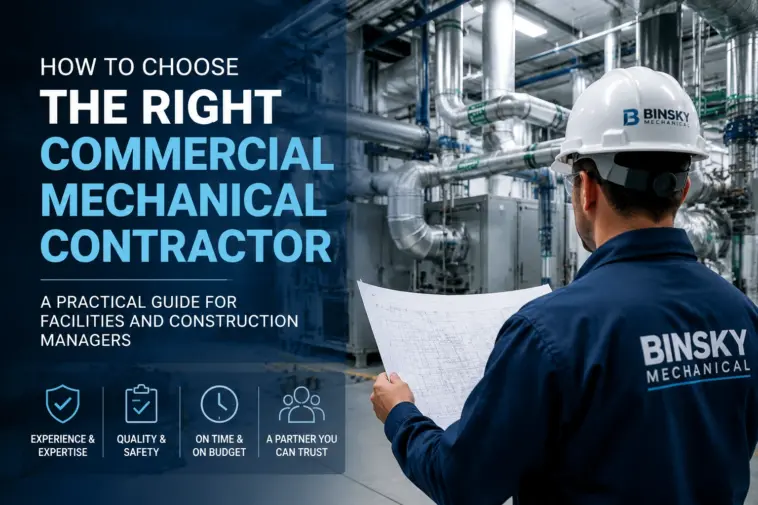
Walk into any modern commercial building — a hospital, a pharmaceutical facility, a university campus, a data center, or a corporate headquarters — and the experience is shaped almost entirely by systems you cannot see. The temperature is controlled. Water runs reliably. Electrical systems power every workstation and piece of equipment. Air quality meets strict regulatory standards. In high-demand environments like life sciences or healthcare, those systems are not just comforts — they are mission-critical infrastructure.
Behind all of it is a mechanical contractor. And in the commercial and industrial world, the quality of that contractor determines whether a project is delivered on time and within budget, or whether it becomes an expensive, disruptive problem. Firms like binsky mechanical — a contractor with over 80 years of experience serving pharmaceutical giants, major universities, healthcare systems, and large-scale construction projects across New Jersey and Eastern Pennsylvania — represent what it looks like when mechanical contracting is done at the highest level. Understanding what separates that caliber of contractor from average alternatives is essential for any facility manager or construction decision-maker.
This guide covers exactly that.
What Commercial Mechanical Contracting Actually Encompasses
The term “mechanical contractor” is broader than many facility and construction professionals initially assume. In a commercial context, it is not simply about HVAC installation. A full-service mechanical contractor operates across an integrated suite of disciplines that together constitute the functional core of any building or facility.
HVAC Systems
Heating, ventilation, and air conditioning remains the primary discipline — and the most operationally consequential for most commercial clients. Commercial HVAC systems bear no resemblance to residential units. They are complex, zoned systems engineered for specific occupancy loads, regulatory requirements, and energy performance targets. For pharmaceutical and life sciences facilities, HVAC is directly tied to product integrity and regulatory compliance — a poorly functioning system is not an inconvenience, it is a production shutdown and potentially a compliance violation.
A qualified commercial HVAC contractor handles design, installation, commissioning, ongoing maintenance, and emergency service — all with the documentation required for facilities operating under FDA oversight or similar regulatory environments.
Industrial Plumbing
Industrial plumbing in commercial and institutional settings is an entirely different category from the plumbing most building owners are familiar with. Large-scale commercial plumbing encompasses process piping, high-purity water systems, medical gas lines, steam and condensate return systems, backflow prevention on industrial scale, and hygienic piping certified to pharmaceutical or food-grade standards.
The materials, tolerances, welding certifications, and documentation requirements for industrial plumbing in sectors like pharmaceuticals, healthcare, and semiconductor manufacturing are demanding by design. A contractor without specific expertise and appropriate certifications — including Section IX-certified orbital welders for hygienic applications — creates real liability and operational risk for the client.
Electrical Systems
Commercial electrical work covers power distribution, lighting systems, emergency power, uninterruptible power supply integration, and the increasingly complex low-voltage systems that underpin building automation, communications, and security infrastructure. In high-dependency environments like data centers or hospitals, electrical system reliability is an absolute requirement — not a preference.
Preventative Maintenance and Building Automation
Beyond installation and construction, leading mechanical contractors provide ongoing maintenance programs that keep systems performing to specification over their full operational lifespan. Modern building management systems (BMS) — increasingly sophisticated platforms that monitor and control HVAC, lighting, electrical, and plumbing systems from a central interface — require contractors who can both install and service the underlying technology competently.
The True Cost of Choosing the Wrong Contractor
This is where many facility managers learn an expensive lesson. The lowest bid is rarely the lowest total cost. The gap between a qualified, experienced mechanical contractor and a cheaper alternative typically materializes in predictable ways:
Schedule failures. Mechanical work is often on the critical path of a construction project. Delays in HVAC rough-in, piping installation, or electrical work cascade into every other trade. A contractor who falls behind schedule does not just affect their own scope — they push back occupancy dates, extend general contractor overhead, and in some cases trigger contractual penalties for the building owner.
Rework and change orders. Contractors who lack design expertise or rush through engineering reviews produce work that requires revision. Rework is expensive — it consumes materials twice, labor twice, and in occupied facilities, it disrupts operations while the corrections are made.
Commissioning failures. A system that installs correctly but does not commission properly can take weeks or months to resolve. In pharmaceutical or healthcare environments, commissioning failures mean operational delays with significant financial consequences.
Long-term operational underperformance. Systems installed without proper engineering oversight often run inefficiently, consume excess energy, and require more frequent maintenance than correctly designed and installed systems. The cost accumulates over years.
Regulatory and compliance risk. In regulated industries, mechanical systems require specific documentation trails. A contractor without experience in FDA-regulated environments, hospital construction standards, or similar frameworks creates compliance exposure that can be extremely costly to remediate.
Key Capabilities to Evaluate When Selecting a Contractor
1. Industry-Specific Experience
Commercial mechanical contracting is not one-size-fits-all. A contractor with deep expertise in pharmaceutical manufacturing understands cGMP requirements, cleanroom standards, and validation documentation. A contractor experienced in healthcare construction understands infection control protocols during construction, medical gas system requirements, and the operational sensitivities of working in occupied clinical environments.
The industries served by a contractor are a direct indicator of the regulatory and technical demands they are equipped to handle. Contractors who have delivered projects for the world’s leading pharmaceutical companies, major hospital systems, and research universities have been tested against the most demanding standards in commercial construction.
2. Engineering and Design Capability
The best mechanical contractors do not just execute someone else’s design — they bring engineering depth that adds value from the earliest stages of a project. This includes the ability to conduct detailed design reviews that identify problems before construction begins, propose value engineering options that reduce cost without compromising performance, and model complex systems using Building Information Modeling (BIM) to eliminate coordination conflicts before they appear in the field.
BIM and virtual construction capabilities have become a meaningful differentiator in the industry. Detailed 3D models of mechanical systems identify clashes with structural elements, other trade work, and architectural features that would otherwise be discovered only during installation — at far greater cost to resolve.
3. Prefabrication and Modular Capabilities
Leading mechanical contractors have invested in prefabrication and modular construction capabilities that deliver significant advantages to clients. By fabricating pipe spools, equipment assemblies, and modular mechanical systems in a controlled shop environment, contractors achieve tighter tolerances, more consistent quality, and faster field installation timelines than field fabrication alone allows.
For large-scale projects where schedule compression is a priority, prefabrication is not a nice-to-have — it is a strategic tool. Modular construction, where complete mechanical systems are assembled offsite and installed as integrated units, pushes this advantage further, allowing parallel construction tracks that would be impossible with traditional sequential field work.
4. 24-Hour Emergency Service
Commercial facilities do not operate on a nine-to-five schedule, and mechanical system failures do not either. A hospital HVAC failure, a pharmaceutical facility process cooling issue, or a commercial building plumbing emergency demands immediate, qualified response — not a next-business-day appointment.
The availability of 24-hour industrial emergency services is a practical requirement for any facility with critical operations. Verify that a contractor’s emergency response is staffed by qualified technicians with access to parts and equipment — not simply an answering service that logs calls for morning follow-up.
5. Safety Record and Culture
Safety performance is a direct indicator of operational maturity. Contractors with strong safety cultures maintain lower incident rates, fewer project delays from safety-related stoppages, and lower insurance costs — savings that ultimately benefit clients. In regulated environments like pharmaceutical facilities and hospitals, contractor safety performance is often a formal qualification criterion reviewed during vendor selection.
Look for contractors who maintain in-house safety teams, conduct regular safety training, and can document their OSHA incident rate history. Safety built into process and culture produces consistently better outcomes than safety enforced only after incidents occur.
6. Financial Stability and Capacity
Large commercial and industrial projects require contractors who can carry the financial capacity to mobilize resources, purchase materials, and sustain operations through project completion. A contractor who is financially overextended creates project risk — the risk of demobilization, subcontractor payment disputes, and in the worst cases, contractor failure mid-project.
For significant projects, it is reasonable to request evidence of bonding capacity, banking relationships, and the contractor’s current project backlog relative to their workforce and resource capacity.
Questions Every Facility Manager Should Ask
Before awarding a mechanical contract, these questions separate qualified contractors from those who simply look credible on paper:
- Can you provide references from projects of similar scope and complexity in our specific industry?
- What is your current OSHA incident rate, and how does it compare to the industry average?
- What portion of this work will you self-perform versus subcontract, and how do you qualify and manage your subcontractors?
- How do you handle design conflicts or field conditions that differ from the drawings?
- What is your commissioning process, and how is it documented?
- What does your warranty coverage include, and what is your typical response time for warranty calls?
- How do you manage schedule when material lead times or labor availability creates pressure?
- Do you have specific experience with the regulatory environment our facility operates under?
The quality of the answers — and the contractor’s comfort level with the questions — is itself revealing.
The Value of a Long-Term Partnership
The most sophisticated facility managers and construction owners have moved away from purely transactional contractor relationships toward long-term partnerships with mechanical contractors who understand their facilities deeply. There are concrete reasons for this.
A contractor who has worked in your facilities over multiple projects knows your systems, your standards, your regulatory environment, and your operational priorities. They can respond more quickly to emergencies because they already know the infrastructure. They can identify preventive maintenance opportunities before failures occur because they understand the history of the equipment. They can advise on capital planning for system upgrades or replacements from a position of genuine knowledge rather than speculation.
This accumulated institutional knowledge has real operational and financial value. The transaction cost of re-qualifying a new contractor for every project — the learning curve, the documentation requirements, the relationship building — is a genuine overhead. Long-term contractor relationships eliminate it.
Conclusion: Mechanical Contracting as a Strategic Decision
The choice of a commercial mechanical contractor is not a procurement exercise — it is a strategic decision with consequences that play out over the life of a facility. The systems a mechanical contractor installs and maintains determine whether a building operates reliably, efficiently, and in compliance with applicable standards for decades. The contractor’s performance during construction determines whether a project is delivered on time and within budget, or whether it becomes an expensive disruption.
Selecting a contractor with genuine engineering depth, industry-specific expertise, advanced construction capabilities, and a proven track record of delivering complex projects for demanding clients is the kind of decision that pays dividends long after the project closeout meeting.
In an industry where the cost of failure is high and the value of reliability is higher, choosing the right mechanical contractor is one of the most important calls a facility manager or construction owner makes.