


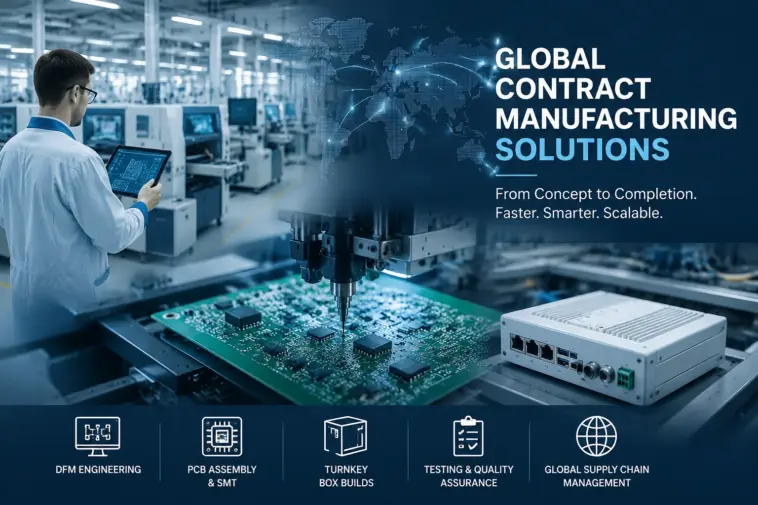
Building a physical product has never been more complex — or more competitive. Whether you are developing an industrial control system, a medical monitoring device, or an AI-powered edge computing unit, the gap between a working prototype and a scalable, market-ready product involves a labyrinth of engineering decisions, sourcing challenges, quality standards, and production logistics.
For most companies, trying to manage all of that in-house is neither practical nor cost-effective. That is why global contract manufacturing has become the backbone of modern hardware product development. Partners like electrical design engineering firm East West Manufacturing have built their entire model around solving exactly this challenge — offering an integrated suite of services that takes products from concept and prototype all the way through to high-volume production, all under one roof.
In this article, we explore what global contract manufacturing solutions actually involve, why they have become indispensable for companies in industries like industrial automation, medical technology, and artificial intelligence, and what to look for when choosing the right manufacturing partner for your product.
What Is Contract Manufacturing — And Why Does It Matter?
Contract manufacturing is the practice of outsourcing all or part of a product’s production to a specialized third-party manufacturer. Rather than building and maintaining your own production facilities, equipment, and workforce, you partner with a contract manufacturer (CM) that provides the infrastructure, expertise, and processes to build your product at the quality level and volume you need.
At its most basic, contract manufacturing covers physical assembly. At its most sophisticated, it spans the entire product lifecycle — from early design reviews and component sourcing through to testing, packaging, and fulfillment.
Why Companies Choose Contract Manufacturing
The business case for contract manufacturing is compelling across company sizes and stages:
Startups and early-stage companies can access industrial-grade manufacturing capabilities without the capital expenditure of building their own facilities. This dramatically lowers the financial barrier to bringing a hardware product to market.
Mid-sized companies benefit from the ability to scale production up or down rapidly without the overhead of maintaining excess capacity. A contract manufacturer absorbs the variability of demand.
Enterprise manufacturers use contract partners to expand geographic reach, reduce costs through labor and supply chain advantages, and free internal teams to focus on design, sales, and strategy.
Medical and regulated industries rely on contract manufacturers with deep compliance expertise — ISO certifications, FDA-compliant processes, validated testing protocols — that would be enormously expensive to build independently.
The result is a manufacturing model that is faster, more flexible, and often significantly less expensive than vertical integration.
The Core Services of a Full-Service Contract Manufacturer
Not all contract manufacturers are created equal. A basic CM might offer assembly services and little else. A full-service, globally integrated partner offers a far broader and more strategically valuable set of capabilities.
Electronics Manufacturing Services (EMS)
Electronics Manufacturing Services is the umbrella term for the full spectrum of electronic product assembly and production. EMS providers handle the transformation of design files and raw components into finished electronic products ready for market.
A strong EMS partner brings together engineering expertise, state-of-the-art equipment, rigorous quality systems, and supply chain infrastructure into a single, coordinated workflow. This integration is what allows complex electronic products to be produced reliably at scale without constant intervention from the client’s internal team.
PCB Assembly and Surface Mount Technology (SMT)
Printed circuit board (PCB) assembly is the heart of virtually every modern electronic product. Surface Mount Technology (SMT) is the dominant PCB assembly method — components are mounted directly onto the surface of the PCB rather than being threaded through holes, enabling far higher component density, smaller board sizes, and faster automated assembly.
High-quality SMT assembly requires precision equipment, tight process controls, and experienced engineers who understand the nuances of solder paste application, reflow oven profiling, component placement tolerances, and inspection protocols. A single poorly soldered joint in a medical device or industrial controller can mean product failure in the field — an outcome with consequences that range from costly warranty claims to genuine safety incidents.
Modern PCB assembly lines combine automated screen printing, pick-and-place machines, reflow soldering, and automated optical inspection (AOI) to achieve the consistency and accuracy that manual assembly simply cannot match at volume.
Turnkey Box Builds
A turnkey box build takes the manufacturing relationship beyond the PCB to the complete, finished product. This includes mechanical assembly, cable harness integration, enclosure fabrication and assembly, labeling, and final product testing — everything required to produce a shippable, market-ready unit.
Turnkey manufacturing is valuable because it reduces the coordination burden on the client dramatically. Rather than managing separate vendors for the PCB, the mechanical assembly, the enclosure, and the final test, a single partner handles the entire product. This simplifies project management, compresses timelines, and creates clear accountability for the finished product’s quality.
Engineering Support: Where the Real Value Gets Built
The most significant differentiator between commodity assembly services and a truly strategic manufacturing partner is engineering depth. Companies that engage their CM early in the design process — rather than only at the point of production — consistently achieve better outcomes across cost, quality, and time to market.
Design for Manufacturability (DfM)
Design for Manufacturability is a structured engineering process that reviews a product’s design with an explicit focus on how it will be manufactured. A DfM analysis identifies design decisions that will create problems during production — and proposes solutions before a single unit is built.
Common DfM findings include component placement issues that complicate automated assembly, design choices that create thermal management challenges during reflow soldering, footprint mismatches between schematic symbols and actual component land patterns, tolerance stack-ups that cause assembly variation, and material choices that drive unnecessary cost without performance benefit.
The business impact of DfM is well established. Engineering changes made during the design phase cost a fraction of changes made during pilot production — and a tiny fraction of changes required after product launch. Companies that invest in rigorous DfM reviews consistently see fewer production defects, lower scrap rates, smoother ramp-ups, and reduced total product cost.
For companies building products in regulated industries like medical or industrial, DfM also helps ensure that the manufacturing process can be validated and documented to the standards required by certifying bodies.
Component Sourcing and Procurement
The component sourcing landscape has become one of the most strategically complex areas of hardware product development. Supply chain disruptions, component shortages, lead time volatility, and the persistent threat of counterfeit components have made sourcing a discipline in its own right.
A contract manufacturer with strong electrical engineer design capabilities and deep supply chain relationships brings enormous value here. Preferred supplier relationships with authorized distributors provide access to genuine components, better pricing, and priority allocation during shortage periods. The ability to qualify alternative components and second-source critical parts reduces single-point-of-failure risk in the supply chain.
Component sourcing is also where significant cost optimization happens. A CM with high aggregate purchasing volume across multiple clients negotiates pricing that individual companies cannot match independently. For cost-sensitive products, strategic component sourcing can be the difference between a commercially viable product and one that cannot be priced competitively.
Testing and Quality Assurance
Testing is where the investments made throughout the design and manufacturing process are validated — or where failures surface before they reach customers. A comprehensive test strategy for electronic products typically includes multiple layers:
In-Circuit Testing (ICT): Verifies that individual components are correctly placed, properly soldered, and functioning within specification. ICT fixtures probe the PCB directly to measure component values and check for opens, shorts, and incorrect parts.
Functional Testing: Tests the board or product as an integrated system, exercising its actual functionality under conditions representative of real-world use. Functional test verifies that the product does what it is supposed to do.
Environmental and Stress Testing: For products intended for harsh environments — industrial equipment, outdoor deployments, medical devices — testing under temperature extremes, humidity, vibration, and other stress conditions validates product durability and reliability.
Final Quality Inspection: Visual and dimensional inspection of finished products against defined acceptance criteria before shipment.
The rigor of a manufacturer’s test strategy is a direct indicator of the quality of the products they ship. A CM that cuts corners on testing creates hidden cost for clients in the form of field failures, warranty claims, and brand damage.
Supply Chain Management: The Invisible Engine of Scalable Manufacturing
Even the best-designed product and the most capable manufacturing operation will struggle without effective supply chain management. Components must arrive on time, in the right quantities, at the right quality level, and at the right cost — consistently, across thousands of SKUs and multiple suppliers — for production to run smoothly.
This is one of the most underappreciated capabilities of a world-class contract manufacturer.
Effective supply chain management services encompass far more than simply placing purchase orders. They include demand forecasting and inventory planning to ensure components are available when production needs them without tying up excessive capital in stock. They include supplier qualification and ongoing monitoring to ensure that the components being received meet specification. They include logistics coordination across international freight, customs, and last-mile delivery to ensure materials move efficiently through a global network.
For companies scaling from prototype to volume production, supply chain management is often the most operationally complex transition. A contract manufacturer that has built robust supply chain infrastructure and processes absorbs this complexity, allowing the client company to focus on product development, sales, and customer relationships rather than expediting components from distributors.
Scaling From Prototype to High-Volume Production
One of the most strategically valuable things a contract manufacturing partner provides is a clear, structured pathway from early prototypes to high-volume production. This transition is where many hardware companies encounter unexpected challenges — and where the difference between a CM with deep process experience and one without becomes starkly apparent.
Prototype and NPI (New Product Introduction)
New Product Introduction is the phase where a design moves from engineering validation to production readiness. During NPI, the manufacturing process itself is designed, documented, and validated. Jigs and fixtures are built. Test procedures are developed and verified. Quality checkpoints are defined. Bills of materials are finalized. Supply chain positions are established.
NPI done properly is an investment in production stability. Companies that rush through NPI to save time almost universally pay for it later in production ramp-up problems, quality escapes, and schedule delays.
Pilot Production
Pilot production runs — producing a small but real production quantity under full production conditions — validate that the NPI work has been done correctly. Pilot builds surface any remaining issues before full-volume commitments are made to component inventory and production capacity.
High-Volume Production
With a solid NPI foundation, the transition to high-volume production is a managed, predictable process rather than a scramble. Production efficiency improves as operators build familiarity with the product. Yields stabilize. Cycle times compress. Cost per unit decreases as volume scale is achieved.
The ability to scale production in response to market demand — increasing volumes when demand grows, managing inventory efficiently during slower periods — is one of the most operationally valuable capabilities a contract manufacturing partner provides.
Industries Driving Global Contract Manufacturing Growth
Industrial Automation and Control
Industrial hardware demands exceptional reliability in often challenging environments — vibration, temperature extremes, electromagnetic interference, continuous duty cycles. Contract manufacturers serving this sector bring deep expertise in ruggedized design, rigorous testing protocols, and quality systems capable of supporting long product lifecycles.
Medical Devices and Healthcare Technology
The medical device industry operates under some of the most demanding regulatory and quality requirements of any sector. Contract manufacturers in this space must maintain ISO 13485 certification, support FDA quality system requirements, and provide the documentation and traceability that regulatory submissions and audits demand. Getting this right requires not just technical capability but deep regulatory knowledge that takes years to develop.
Artificial Intelligence and Edge Computing Hardware
AI hardware represents one of the fastest-growing segments in electronics manufacturing. From edge inference modules and AI accelerator boards to intelligent sensor systems and connected industrial IoT devices, the complexity and performance requirements of AI hardware push manufacturing processes to their limits. Thermal management of high-power processors, high-speed signal integrity on dense PCB layouts, and the need for rigorous functional validation of intelligent systems all demand manufacturing partners with serious technical depth.
How to Choose the Right Contract Manufacturing Partner
With so much at stake, the selection of a contract manufacturing partner is one of the most important decisions a hardware company makes. Key criteria to evaluate:
Engineering depth: Does the CM have engineers who can engage meaningfully with your design — not just assemble it? The ability to conduct genuine DfM reviews, identify component risks, and propose design improvements is a strong differentiator.
Industry experience: Has the CM manufactured products in your industry before? The nuances of medical device manufacturing are very different from consumer electronics. Sector-specific experience dramatically reduces risk.
Quality certifications: ISO 9001 is a baseline. For medical devices, ISO 13485 is essential. For automotive, IATF 16949 matters. Certifications are indicators of system maturity, not just credentials.
Supply chain infrastructure: What is the CM’s relationship with component suppliers? How do they manage shortages and lead time volatility? What traceability systems do they maintain?
Transparency and communication: A manufacturing partner who communicates proactively — sharing production data, flagging risks early, collaborating on problem resolution — is worth far more than one who simply ships parts and sends invoices.
Scalability: Can the CM grow with you from prototype to millions of units? Changing manufacturing partners mid-scale is disruptive and costly. Choose a partner capable of supporting your long-term growth trajectory.
Conclusion: The Strategic Value of the Right Manufacturing Partner
In today’s hardware landscape, the companies that win are not necessarily those with the most innovative designs — they are the ones that can execute those designs into reliable, cost-effective, scalable products faster than their competition.
Global contract manufacturing, done right, is the enabler of that execution. From rigorous DfM engineering and precision PCB assembly to expert supply chain management and validated testing protocols, a world-class manufacturing partner transforms the impossible complexity of hardware product development into a manageable, repeatable process.
For companies in industrial, medical, AI, and adjacent sectors, finding a partner with the engineering depth, supply chain infrastructure, and production capabilities to support the full journey from prototype to volume production is not just a procurement decision — it is a strategic competitive advantage.
The best time to engage your manufacturing partner is earlier than you think. Before the design is locked. Before the BOM is finalized. Before the supply chain positions are set. That early engagement is where the real value gets created — and where the foundation for a successful product launch is built.