


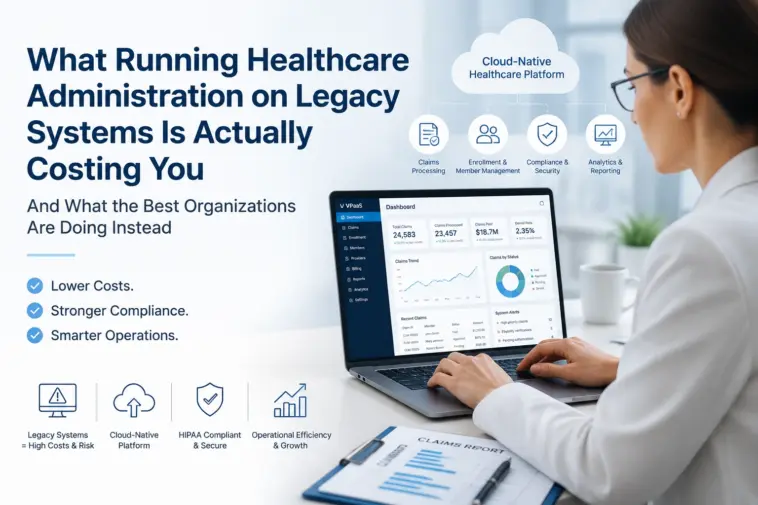
I want to start with a number that never stops surprising the people I share it with: administrative costs consume roughly 34 cents of every dollar spent in the American healthcare system. Not clinical care. Not drugs. Not capital equipment. Administration. Billing, claims processing, enrollment, prior authorization, eligibility verification, provider credentialing, premium collection — the operational machinery that keeps the system running. And yet, most of that machinery is still powered by fragmented legacy systems that were never built for the volume, complexity, or compliance demands of modern healthcare. The organizations closing that gap fastest are the ones that have moved to a purpose-built vpaas — a Platform as a Service designed specifically for healthcare administration — rather than patching infrastructure that was already showing its age a decade ago.
When I started consulting with insurers and TPAs two decades ago, that number felt like a fixed law of nature. Healthcare administration was complicated, labor-intensive, and expensive, and the systems running it were built to manage complexity through headcount rather than eliminate it through automation. Then the cloud arrived, and the organizations that recognized what it actually meant — not cheaper storage, but a fundamentally different architecture for what healthcare administration systems could do — started pulling away from those still treating cloud migration as an IT refresh rather than an operational transformation.
I have watched both groups up close for years. The gap between them is now significant enough that it is becoming a competitive disadvantage for the organizations on the wrong side of it. If you run a TPA, an insurer, or a provider network and you are still running claims and enrollment on on-premise legacy infrastructure, the cost of that decision is compounding every month — in operational overhead, compliance exposure, and the widening distance between your capabilities and those of organizations that have made the shift. The right response is not another round of legacy system patches. It is a genuine platform modernization, built on cloud-native architecture designed specifically for healthcare administration. Platforms like the vpaas offered by MCSI – Visova — a healthcare administration technology provider trusted since 1997, with SOC 2 Type II certification, HIPAA support, dedicated implementation support, and 99.9%+ uptime — represent what that modernization looks like when it is done by people who have spent decades understanding the specific operational pressures of healthcare administration, not just the technology side of the equation. Their cloud-native, HIPAA-compliant Platform as a Service handles automated claims processing, enrollment, member management, premium billing, provider network management, capitation, and HRA/HSA integration — end-to-end, in a single platform, for insurers, TPAs, and provider networks that are ready to stop fighting their infrastructure and start running their business.
Here is what I have seen, what it costs, and what doing it right actually looks like.
The Real Cost of Legacy Infrastructure — And Why It Is Invisible Until It Isn’t
The most insidious thing about legacy healthcare administration systems is that their true cost is almost never visible in a single line item. It accumulates across a dozen different budget lines, operational inefficiencies, and risk categories that most organizations track separately — and therefore never see as the interconnected consequence of a single strategic decision.
The IT Infrastructure Cost Nobody Fully Accounts For
On-premise healthcare administration infrastructure requires servers, network equipment, storage systems, database licenses, security hardware, backup infrastructure, and the IT staff to maintain all of it. These costs are real and budgeted. What is less consistently budgeted is the lifecycle management of that infrastructure — the refresh cycles every five to seven years, the unplanned replacement when hardware fails outside the refresh schedule, and the increasingly expensive software licensing as platforms approach end-of-life.
Running healthcare administration on legacy on-premise systems means spending more time and money maintaining infrastructure than you would on a modern alternative — and falling behind competitively in every conversation with a prospective client.
What I consistently find when I help organizations build a true total cost of ownership model for their legacy infrastructure — including maintenance, lifecycle management, security patching, and the IT staff time associated with keeping the lights on — is that the number is substantially higher than what appears in the IT budget. The portion of that cost attributable to keeping legacy systems operational, rather than delivering new capability, is effectively wasted.
Tip #1: Build a genuine total cost of ownership model for your current administration infrastructure before evaluating alternatives. Include hardware, software licensing, IT staff time allocated to maintenance versus development, refresh cycles, and the cost of the downtime events you have actually experienced in the past three years. The number you arrive at will change the financial conversation about platform modernization entirely.
Claims Processing: Where Legacy Limitations Hit Hardest
If I had to identify the single function where legacy healthcare administration systems are most visibly failing the organizations that depend on them, it would be claims processing. The volume, the complexity, the regulatory demands, and the financial stakes all converge here — and legacy systems built for the claims environment of fifteen years ago are straining under the weight of what that environment looks like today.
The Adjudication Backlog Problem
The complete journey of a healthcare claim through an automated processing pipeline — from intake to fulfillment and beyond — involves an intelligent, rules-driven lifecycle solution that covers every step from intake to payment and analytics. Legacy systems typically handle pieces of this lifecycle with separate modules, manual handoffs between systems, and exception queues that require human review for anything the automated rules cannot resolve.
The consequence is claims backlogs. When claim volume spikes — during open enrollment periods, after a large group acquisition, or following a regulatory change that affects how existing claim types must be processed — legacy systems do not scale to absorb the additional volume. Queues grow. Turnaround times extend. Provider relations suffer. Compliance timelines for claims payment get stressed. And the staff cost of working through the backlog represents real, unbudgeted expense.
Cloud-native claims adjudication software eliminates the capacity constraint that creates backlogs. Because the platform scales with demand rather than being limited by fixed server capacity, volume spikes are absorbed by the platform architecture rather than by claims staff working overtime. A unified, automated healthcare administration platform replaces fragmented systems and manual workflows with an intelligent, rules-driven lifecycle solution that enables organizations to operate more efficiently, reduce costs, and scale with confidence.
Tip #2: Pull your claims turnaround time data for the past 24 months and map it against your volume curve. If your turnaround time degrades when volume increases — even temporarily — you have a capacity constraint in your claims processing architecture that is costing you in provider relations, compliance risk, and staff cost. That degradation is a quantifiable business case for platform modernization.
The Claim Routing Complexity Nobody Planned For
One of the dimensions of claims processing complexity that has expanded significantly in the past decade is routing — determining which payer, which benefit layer, which contract, and which payment rail should apply to a given claim. The proliferation of value-based care arrangements, multi-payer coordination structures, stop-loss configurations, and specialty benefit carve-outs has made routing logic far more complex than it was when most legacy systems were designed.
An intelligent claim routing tool that handles this complexity automatically — applying the correct routing logic based on the member’s specific benefit configuration, the claim type, the provider’s contract, and the applicable coverage coordination rules — eliminates a category of manual review work that consumes significant claims staff time in legacy environments. Beyond the core claim lifecycle, comprehensive automation covers essential healthcare administration functions that in legacy systems require manual intervention at multiple points.
Tip #3: Audit your claims exception queue. Specifically identify what percentage of exceptions require manual routing decisions — determining which benefit layer, which payer, or which contract applies. If that percentage is above 10%, you have a routing logic gap in your current system that is likely costing you more in staff time than you have explicitly measured.
Enrollment and Member Management: The Accuracy Problem That Compounds
Claims processing gets the attention because its failures are immediately visible — delayed payments, provider complaints, compliance deadlines. Enrollment and member management failures are slower and less visible, but they compound in ways that eventually produce larger and more expensive problems.
Enrollment data errors — members with incorrect coverage effective dates, missing plan selections, incorrect benefit levels, or outdated demographic information — propagate through every downstream administrative function. A claim adjudicated against incorrect coverage data produces incorrect payment. A premium billing calculation built on incorrect enrollment data produces incorrect invoices. A provider eligibility verification built on incorrect member data produces incorrect eligibility confirmations that generate provider abrasion and potential liability.
The root cause in legacy environments is almost always the same: enrollment is managed in a system that does not maintain a clean, real-time, single source of truth for member data. Instead, member records exist across multiple systems — enrollment, billing, claims, member portal — with synchronization processes that run on batch schedules and fail silently when exceptions occur.
Cloud-native healthcare administration platforms eliminate this architecture by design. A single member record serves all downstream administrative functions in real time, with updates propagating instantly to every consuming system rather than waiting for a batch synchronization that may or may not complete successfully.
Tip #4: Run a reconciliation audit between your enrollment system, your claims system, and your premium billing system. Specifically look for members who appear in one system but not another, or who have different coverage effective dates across systems. The percentage of discrepant records you find is a direct measure of the synchronization gap your current architecture is producing — and a preview of the claims payment errors and billing discrepancies those discrepancies are generating downstream.
Premium Billing and Capitation: Where Financial Accuracy Is Non-Negotiable
If enrollment errors are slow and accumulating, premium billing and capitation errors are fast and expensive. Premium billing errors — whether overpayments, underpayments, or timing errors — create accounting reconciliation work, employer relations issues, and sometimes contractual complications that are time-consuming and expensive to resolve. Capitation payment errors in value-based care arrangements can produce financial exposure that takes months to identify and quarters to work out.
The source of most premium billing and capitation errors I have investigated is not arithmetic — the calculations themselves are usually correct given the inputs they receive. The source is the inputs: enrollment data that is not current, benefit configuration that is not accurately reflected in the billing system, or capitation rosters that lag actual member attribution.
This is exactly the kind of problem that integrated cloud-native platforms resolve by design. When enrollment, benefit configuration, and billing all operate from the same data layer — updated in real time rather than synchronized on a batch schedule — the input accuracy problem disappears. Premium bills reflect actual enrollment as of the billing date. Capitation payments reflect actual attributed member populations. Reconciliation work decreases dramatically because the conditions that create reconciliation work — data discrepancies between systems — have been eliminated at the architectural level.
Tip #5: Calculate the staff hours spent on premium billing reconciliation and capitation dispute resolution per month. Convert that to an annual cost. That number is your minimum baseline business case for integrated billing and enrollment automation — the benefit you can quantify before adding any revenue recovery or error reduction component.
HIPAA Compliance in the Cloud: Correcting the Security Misconception
I want to address something directly, because I still encounter it regularly: the belief that on-premise systems are inherently more secure than cloud platforms for HIPAA-regulated healthcare data.
There was once a persistent myth that keeping servers physically inside a corporate office was more secure than utilizing the cloud. Modern cybersecurity realities have completely shattered that notion. Maintaining physical servers requires a massive, dedicated IT staff to constantly patch vulnerabilities, update firewalls, and ensure physical security. Cloud-native platforms operate in highly fortified, enterprise-grade environments inherently designed from the ground up to meet the rigorous standards of the HHS HIPAA Security Rule, offering encryption, automated backups, and disaster recovery protocols that few standalone companies could ever afford to build on their own.
The healthcare data breach statistics bear this out. The majority of significant PHI breaches in recent years have occurred at organizations running on-premise infrastructure, with breach vectors including unpatched server vulnerabilities, inadequate access controls, and physical security failures that cloud platforms structurally eliminate.
The 2026 updates to the HHS HIPAA Security Rule introduce strict mandates including universal, mandatory encryption of electronic PHI both at rest and in transit — requirements that cloud-native platforms designed for healthcare administration are positioned to meet as a native capability, while on-premise organizations face additional infrastructure investment to achieve the same compliance posture.
A compliant VPaaS platform provides 24/7 security evaluation with real-time threat detection and response capabilities, secure and scalable infrastructure with 99.9%+ uptime, automatic security patches and system updates, and role-based access with multi-factor authentication and comprehensive audit trails. This security posture — maintained by the platform provider’s dedicated security team — represents a level of investment that most individual healthcare administration organizations cannot justify building independently.
Tip #6: Audit your current HIPAA Security Rule compliance posture against the 2026 rule updates, specifically the new encryption mandates and security program requirements. Document the gaps and the investment required to close them with your current on-premise infrastructure. This exercise frequently produces the most compelling single component of the business case for cloud-native platform migration.
HRA and HSA Integration: The Consumer Health Benefit Complexity Everyone Underestimates
Consumer-directed health benefits — Health Reimbursement Arrangements and Health Savings Accounts — have become a significant component of commercial health benefit design over the past decade. For TPAs and insurers administering self-funded employer benefit programs, the integration of HRA and HSA administration into the broader claims and benefit management workflow represents a complexity layer that legacy systems handle inconsistently at best.
The integration points matter because HRA and HSA balances affect how claims are paid — specifically, which payment layer covers which portion of a claim depends on the member’s current account balance, the account structure rules, and the claim type. In a legacy environment where HRA/HSA administration is handled by a separate system with a batch interface to the claims platform, balance information is never fully current, account rules are not consistently applied, and the manual exception handling required to reconcile the gaps consumes staff time that should be spent on higher-value activities.
An integrated cloud-native platform where HRA/HSA balance data, account rules, and claim adjudication logic operate in the same environment eliminates this integration gap. Account balances are current at the time of adjudication. Payment application follows account rules automatically. The manual exception queue that exists in every legacy environment I have reviewed — members where account balances and claim payment did not coordinate correctly — either disappears or shrinks to a small fraction of its current volume.
Tip #7: Count the number of manual adjustments your claims staff makes per month related to HRA or HSA payment application errors — claims where the account balance information was not current at the time of adjudication, or where the account rules were not correctly applied. Multiply by your average staff cost per manual adjustment. That number is the monthly cost of your HRA/HSA integration gap.
Provider Network Management: The Credentialing and Contract Accuracy Challenge
Provider network management is one of the least glamorous functions in healthcare administration and one of the most consequential when it goes wrong. An out-of-network claim paid at in-network rates because the claims system was not current on the provider’s contract status represents direct financial loss. A claim denied for out-of-network billing when the provider is actually contracted creates provider abrasion, member appeals, and staff rework. A credentialing lapse that allows a provider to bill under a credential that has expired creates compliance exposure.
Legacy provider network management is typically maintained in a system that requires manual updates when provider contracts change, when credentialing status is renewed or lapsed, or when network participation changes. The lag between real-world contract and credentialing status and what the claims system knows about it is where errors originate.
Cloud-native platforms designed for healthcare administration eliminate this lag by integrating provider network status directly into the claims adjudication logic — so the network status applied to a claim reflects the provider’s actual contract and credential status at the time the claim is adjudicated, not whatever the system knew at the last manual update.
Tip #8: Pull a sample of 100 claims from each of the past three months where network status affected the payment determination. Verify the network status applied in adjudication against the actual provider contract and credential status as of the date of service. The error rate you find is the error rate your current provider network management integration is producing — with direct financial implications in both directions.
The Implementation Reality: What Migration Actually Involves
Every healthcare administration technology conversation eventually reaches the same question: what does implementation actually involve, and how disruptive is it?
I want to be honest about this because I have seen implementation projects go both ways — smoothly executed transitions that delivered operational benefits ahead of schedule, and difficult migrations that took longer than planned and created temporary operational disruption. The difference, in every case I have reviewed, came down to implementation methodology and the expertise of the people executing it.
Healthcare administration platform implementation is not a generic enterprise software deployment. The data migration from legacy systems — claims history, member records, provider contracts, benefit configurations, financial records — requires healthcare domain expertise as well as technical skill. The workflow mapping process, where current-state processes are translated into platform configuration, requires people who understand how healthcare administration actually works operationally. And the testing protocols, where adjudication rules, enrollment processes, and billing calculations must be validated against expected outcomes before go-live, require rigor that general IT project managers do not bring to the table without healthcare-specific experience.
In healthcare administration, software is only part of the solution. Organizations also need people who understand the operational pressure behind the software: claims volume, plan complexity, employer expectations, provider relationships, regulatory deadlines, and the need for the system to work reliably under all conditions.
Tip #9: Before selecting a platform provider, ask specifically who will execute your implementation — internal consulting staff with healthcare administration backgrounds, or third-party implementers with limited domain knowledge. Ask to speak with two or three clients whose implementation scope was comparable to yours. Ask those references specifically about the implementation team’s understanding of healthcare administration operations — not just the technology. The gap between a technically competent implementation team with shallow healthcare knowledge and one with genuine domain depth is real, and it shows up in go-live quality.
Building the Business Case: What to Measure Before You Start the Conversation
The organizations I work with that successfully execute healthcare administration platform modernizations share one thing: they go into the vendor selection process with a clear, quantified picture of what their current platform is costing them. Not a vague sense that legacy systems are expensive and cloud is cheaper — a specific, documented analysis of current-state costs and performance gaps that translates directly into a modernization ROI calculation.
The components of that analysis that I consistently find most compelling to decision-makers:
Current IT infrastructure total cost (hardware, software licensing, maintenance staff, refresh cycles, security): establishes the baseline infrastructure cost that a cloud platform subscription replaces.
Claims processing cost per claim (staff time, exception handling, rework, manual adjustments): establishes the operational efficiency baseline that automated adjudication improves against.
Claims error and rework volume (incorrect payments, coordination errors, routing mistakes): establishes the financial loss and recovery cost that improved adjudication accuracy eliminates.
Enrollment discrepancy rate (mismatches between enrollment, claims, and billing systems): establishes the downstream error rate that integrated data architecture eliminates.
Compliance remediation cost (the cost of addressing security and HIPAA compliance gaps in current infrastructure): establishes the compliance investment that cloud-native security architecture avoids.
Scalability cost (the incremental cost of adding processing capacity when volume grows): establishes the capacity constraint value that cloud scaling eliminates.
The VPaaS model gives organizations access to sophisticated, continuously improving infrastructure without the capital investment and IT overhead of building and maintaining it internally — a meaningful advantage in a market where technology investment capacity varies widely and the cost of falling behind keeps rising.
Final Tip — Tip #10: Structure your business case as a five-year model, not a first-year comparison. Cloud-native platform modernization typically has a year-one cost that is higher than status quo, because implementation investment is front-loaded. The financial case becomes compelling when years two through five are included — and the compounding operational efficiency gains, avoided infrastructure refresh costs, and competitive positioning value are visible in a complete model rather than a single-year snapshot.
Where This Leaves Healthcare Administration Organizations in 2026
The window for treating cloud-native platform modernization as a future option is closing. Regulatory tightening, rising claim volumes, and the competitive pressure of organizations already operating on modern platforms are all moving in the same direction — making the cost of delay higher every quarter.
Five years from now, running healthcare administration on an on-premise legacy system is going to feel like running your business email on a server in your closet. It will still technically work. But you will be spending more time and money maintaining it than you would on a modern alternative, and you will be at a competitive disadvantage in every conversation with a prospective client.
I have never worked with an organization that modernized its healthcare administration platform and wished they had waited longer. I have worked with several that waited longer than they should have and paid for it — in compliance exposure, staff turnover driven by operational frustration, and competitive losses to organizations that had already made the shift.
The infrastructure question has been answered. The compliance question has been answered. The implementation question has been answered. What remains is the organizational decision to commit to the modernization that the data has been pointing toward for several years.
Make it sooner rather than later. The compounding cost of the alternative is working against you every day it takes.