


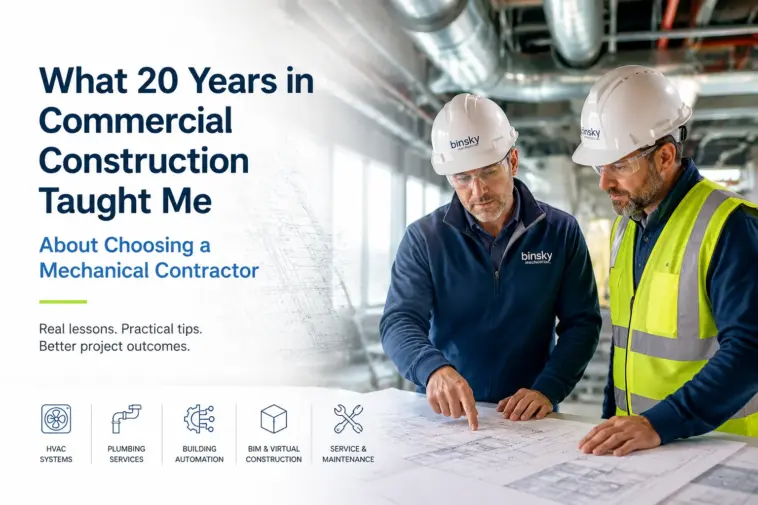
I have sat through more project post-mortems than I care to count. Budget overruns, commissioning failures, HVAC systems that never quite hit setpoint, plumbing rough-ins that had to be torn out and redone two weeks before occupancy. And in nearly every one of those conversations, the root cause traces back to the same decision point: the mechanical contractor. Whether it is commercial HVAC, industrial plumbing, emergency mechanical service, or large-scale construction — the firm you choose to design, install, and maintain your building systems is the single variable that determines whether a project becomes a success story or a cautionary tale. I have seen both outcomes up close, and the difference almost always starts with whether the team chose a proven binsky mechanical -caliber partner or settled for whoever came in lowest at bid day.
Not always a bad contractor. Sometimes a perfectly competent contractor who was wrong for the project scope. Sometimes a contractor who was right on paper but lacked the support infrastructure for the scale of what we were building. Sometimes simply the lowest bid, selected because the project economics demanded it and everyone hoped for the best.
I stopped hoping a long time ago. Now I evaluate mechanical contractors the way I evaluate any mission-critical project risk — systematically, with specific criteria, and with the full understanding that this decision will affect the project outcome more than almost any other single choice we make.
Here is what I have learned. I share it because it took me longer than it should have to figure it out, and because I see the same mistakes made repeatedly by project managers and facility directors who are brilliant at their core disciplines but are operating outside their experience base when it comes to mechanical systems.
The Scope Is Almost Never What You Think It Is
Early in my career, I thought mechanical contracting meant HVAC and plumbing. That is roughly correct the way saying architecture means walls and roofs is roughly correct — technically true and practically incomplete.
A full-service commercial mechanical contractor operates across a scope that, in complex projects, touches virtually every functional system in the building. HVAC design and installation. Commercial plumbing infrastructure. Industrial process piping. Building automation and controls integration. Electrical work in many cases. Prefabrication and modular system manufacturing. Emergency service and ongoing maintenance.
The contractors who can genuinely cover that full scope — not by subcontracting most of it to other firms but by self-performing with qualified tradespeople and experienced engineers — are a different category from those who specialize in one or two disciplines and manage the rest out.
Firms like binsky mechanical — recognized as one of the most respected mechanical contractors in New Jersey and Eastern Pennsylvania — represent what comprehensive mechanical contracting capability actually looks like in practice. With over 80 years of experience and technologies including Building Information Modeling, virtual construction, and digital twinning, they operate at a level of technical sophistication that genuinely changes what a mechanical contractor can deliver on a complex project. I reference them specifically because their client list — Novartis, Pfizer, Merck, University Hospital, research universities — reflects the kind of demanding, mission-critical work that tests a contractor’s depth. Anyone building oncology facilities for pharmaceutical companies is operating at the top of the capability curve.
Tip #1: Before you evaluate a mechanical contractor, write down every system in your building that a mechanical contractor might touch — including ones you are not sure about. Then ask each candidate to tell you how they handle each one. The gaps in their answer tell you more than the parts they cover confidently.
The BIM Conversation Nobody Is Having Honestly
Building Information Modeling has been the construction industry’s favorite buzzword for over a decade. Every contractor claims to do it. Very few use it in ways that actually change project outcomes.
Here is what real BIM looks like in mechanical contracting: a fully coordinated 3D model of the mechanical systems — HVAC distribution, plumbing, piping, electrical — built before a single pipe is cut, clash-detected against the structural and architectural models, and used to drive prefabrication in a shop environment with controlled quality, precise tolerances, and faster field installation.
What fake BIM looks like: a model produced after the design is complete, used primarily to create impressive-looking visualizations for client presentations, with coordination happening the old way — by tradespeople discovering conflicts in the field and resolving them with field modifications.
The difference between the two is not a technology difference. It is a process and commitment difference. Real BIM requires investment in modeling resources, in fabrication capability aligned with the model, and in a project management approach that treats the model as the authoritative source of truth rather than a supplementary communication tool.
Prefabrication and manufacturing services, when properly integrated with BIM workflows, genuinely condense project schedules and enhance productivity — but only when the prefabrication is driven by a model that is accurate, coordinated, and actually used in the field.
Tip #2: When a mechanical contractor says they use BIM, ask to see the clash report from a recent project. A real BIM user can show you dozens or hundreds of coordination issues identified and resolved in the model before construction. A contractor using BIM as a marketing term will struggle to produce this.
Tip #3: Ask whether their prefabrication is model-driven. Specifically ask what percentage of assemblies on a recent comparable project were prefabricated off-site versus fabricated in the field. The answer should be going up year over year for any contractor seriously committed to the technology.
Why I Now Start Every Project Conversation With Emergency Service
This one took me longer than it should have.
In my early years, I evaluated mechanical contractors almost entirely on their construction capability — their experience with projects of our size and type, their engineering depth, their BIM and prefab capability. Emergency service was something I thought about after the building was occupied, when the facilities team was responsible.
I was thinking about it in the wrong sequence.
The mechanical contractor you select for construction will almost always become your emergency service provider, because they know the systems they installed. If a contractor is genuinely excellent at construction but has weak emergency response capability — limited after-hours staffing, slow response time, inadequate parts inventory — you will discover that gap at the worst possible moment: during a building system failure that is disrupting operations or, in mission-critical environments, threatening patient safety or pharmaceutical product integrity.
The contractors who earn long-term relationships with pharmaceutical, healthcare, and higher education clients do so in part because they deliver fast-response 24-hour service alongside their construction capability — understanding that the relationship does not end at substantial completion.
Tip #4: Call a contractor’s emergency service line before you award them a construction contract. Call it on a Saturday evening. Note how quickly someone answers, how knowledgeable they sound, and whether they feel like an emergency resource or an answering service. That call tells you more than a reference check with a facilities director who has never had a crisis.
Tip #5: Ask specifically about their average response time to emergency calls and what their policy is for building occupancy cutoffs. A contractor who guarantees same-day response during business hours but offers no specific commitment for after-hours response is not a true 24-hour emergency service provider.
The Pharmaceutical and Healthcare Standard — And Why Every Facility Should Want It
I spent eight years managing projects in the pharmaceutical construction sector before moving into broader commercial work. Those eight years fundamentally changed how I think about mechanical contracting quality.
Pharmaceutical manufacturing and research facilities impose requirements on mechanical systems — documentation rigor, material traceability, installation quality, commissioning thoroughness, validation readiness — that significantly exceed what is standard in general commercial construction. HVAC systems for clean manufacturing areas must maintain temperature, humidity, and particle count within tight tolerances, continuously, with documented performance evidence. Process piping must be fabricated and installed to specifications that require certified welders and inspection protocols that go well beyond standard commercial practice.
Contractors who work regularly in this environment develop quality habits and process disciplines that benefit every project they touch — not just pharmaceutical work. When I hire a mechanical contractor who routinely works for Novartis or Merck, I am getting a team whose baseline quality standard is calibrated to the most demanding requirements in the industry.
This is not a small thing. The difference between a mechanical contractor whose quality culture is shaped by mission-critical pharmaceutical and healthcare work and one whose culture is shaped primarily by office buildings and retail projects is real and it shows up in the field — in documentation, in installation quality, in how they handle discovered conditions and RFIs, and in how they manage commissioning.
Tip #6: When checking references, specifically ask whether the contractor has delivered projects in regulated industries — pharmaceutical, healthcare, higher education research facilities. If yes, ask about their documentation and quality control practices on those projects. The answer reveals the quality floor beneath everything else they do.
The Budget Conversation Nobody Wants to Have Until It’s Too Late
Mechanical systems are consistently the most value-engineered scope on commercial construction projects. They are also consistently the scope where value engineering produces the most expensive long-term consequences.
I have watched this play out more times than I can count. A project budget is squeezed. The mechanical scope is the biggest number with the most apparent reduction opportunities. HVAC equipment gets downgraded from specified equipment to cheaper alternatives. Distribution system sizing gets reduced. Pipe insulation specifications get relaxed. Controls sequences get simplified. The project delivers under budget. Two years later, the building is using 30% more energy than projected, occupant complaints about comfort are constant, and the equipment that was substituted is requiring maintenance that the better-specified equipment would not have needed.
The total cost of ownership for building mechanical systems over a 20-year service life dwarfs the construction cost. A $200,000 value engineering reduction in HVAC equipment cost can easily produce $400,000 in additional energy cost, $150,000 in additional maintenance cost, and $200,000 in equipment replacement cost over 20 years — a net loss of $550,000 from a decision that looked like a $200,000 savings.
Tip #7: When value engineering mechanical systems, require the contractor and design engineer to jointly model the 20-year life cycle cost impact of each proposed reduction. This one step will eliminate most bad VE decisions immediately, because the math makes the consequences visible before the commitment is made.
Tip #8: Budget for commissioning as a separate line item, not as something the mechanical contractor absorbs in their base scope. Independent commissioning — where a third-party commissioning agent verifies that systems perform as designed before occupancy — consistently catches integration and calibration issues that save multiples of its cost in post-occupancy remediation.
What a Good Project Kickoff Meeting Reveals
I can usually tell within the first hour of a project kickoff meeting whether a mechanical contractor is going to be a genuine partner or a management headache. Specific things I watch for:
Who they send. A contractor who sends a project manager and a superintendent who have clearly reviewed the drawings and have site-specific questions has invested in pre-mobilization preparation. A contractor who sends a salesperson and promises to introduce the actual project team later is telling you something about their priorities.
How they talk about schedule. A contractor who comes to kickoff with a preliminary three-week look-ahead and specific questions about long-lead equipment procurement is thinking about delivery. A contractor who says they will have a schedule ready “by the end of the week” without having one ready at kickoff is already behind in their process thinking.
Their questions. The questions a mechanical contractor asks at kickoff reveal their experience with projects of the type they are working on. Experienced contractors ask about things that are not in the drawings — access conditions for large equipment installation, coordination sequencing with other trades, BIM coordination meeting schedules, commissioning timeline expectations. Inexperienced contractors ask only questions that are answered in the contract documents.
Their approach to coordination. Ask explicitly how they plan to handle trade coordination — specifically what software they use for clash detection and how they manage RFI workflow. The specific, confident answer of an experienced BIM user is immediately distinguishable from the vague, hesitant answer of a contractor who will figure it out as they go.
The contractors who combine experienced engineering with a genuine commitment to budget management and schedule delivery are the ones who show up prepared at every touchpoint — from kickoff through commissioning.
Tip #9: Before the kickoff meeting, send the contractor a short list of five project-specific technical questions — things about the project’s particular coordination challenges or system requirements that an experienced contractor who has read the drawings would have thought about. Their answers will tell you more about their preparation and competence than any reference check.
The Modular Construction Conversation Worth Having
Modular mechanical construction — building complete mechanical plant rooms, utility corridors, or equipment modules in a factory environment and delivering them to site for installation as integrated units — has moved from niche application to mainstream option for the right project types.
The advantages are real and measurable. Factory fabrication produces more consistent quality than field fabrication under weather, space, and logistics constraints. Parallel construction — building the mechanical modules while the building structure goes up simultaneously — compresses overall project schedule in ways that sequential field construction cannot. Factory-built assemblies require less on-site labor, reducing exposure to site conditions and labor availability constraints.
For projects with repetitive mechanical rooms, standardized equipment configurations, or tight schedule constraints, the modular option deserves serious evaluation. The barrier to evaluating it is typically familiarity — both owners and design teams default to conventional construction because it is what they know, not because it is always the best choice.
Contractors who have invested in prefabrication and manufacturing services as a core capability — not as an occasional option — bring a meaningfully different range of delivery options to a project than those who can only deliver through conventional field construction.
Tip #10: Ask your mechanical contractor to specifically evaluate whether any portion of your project’s mechanical scope is a candidate for modular or prefabricated construction. Require a comparison: conventional field construction timeline and cost versus modular or prefab alternative. Even if you ultimately choose conventional construction, the exercise forces a cost and schedule rigor that benefits the project regardless of which path you take.
The Relationship Question That Changes Everything
I want to end with something that does not appear in any RFP evaluation criteria I have ever seen but that has proven, in my experience, to be one of the most reliable predictors of project outcome.
Does the contractor’s leadership team show up when things go wrong?
Not the project manager. Not the superintendent. The people who run the company.
On the best mechanical contracting relationships I have had over 20 years, the firm’s owners or senior leadership appeared on-site when we faced a difficult situation — a late delivery on critical equipment, a commissioning issue that was threatening occupancy, a dispute about scope that could have escalated into a claim. They came, they engaged, they solved the problem, and they treated the resolution as a responsibility rather than a concession.
On the worst relationships, calls to leadership went to voicemail. Escalations disappeared into organizational layers. Problems that should have been resolved in days dragged into weeks because nobody with real authority was invested in fixing them.
This is not something you can verify from a reference list of project names. You verify it by asking references one specific question: “When something went wrong on the project — and something always goes wrong — how did the contractor’s leadership respond?” The answer to that question is the most reliable data point you will get about what it is actually like to work with a firm when the pressure is on.
Family-owned contracting firms with deep roots in their region — where the reputation of the business and the reputation of the family are inseparable — tend to perform differently at this moment than large contractors for whom any single project represents a small percentage of an enormous portfolio. That is not a universal truth, but it is a pattern I have seen consistently enough to take seriously.
Final Tip: During your reference calls, ask the specific question above. Then listen not just to what the reference says, but to how quickly and confidently they answer. A reference who pauses before responding has something worth thinking about. A reference who answers immediately and specifically has given you something valuable.
Where This Leaves You
Choosing a commercial mechanical contractor is one of the highest-leverage decisions on any construction or renovation project. The systems a mechanical contractor installs will determine comfort, energy performance, operational reliability, and regulatory compliance for the life of the building. Their performance during construction will determine whether the project delivers on schedule and within budget, or whether it becomes an expensive, protracted challenge.
Evaluate them accordingly. Ask harder questions than you think you need to. Check references more deeply than feels necessary. Look past the marketing materials to the actual evidence of delivery — the post-mortems they turned around, the schedule recoveries they engineered, the difficult client relationships they preserved by doing what they said they would do.
That standard of evaluation will take more time upfront. It will save you an enormous amount of time, money, and stress on the back end.
I know this because I learned most of these lessons the hard way. You do not have to.