


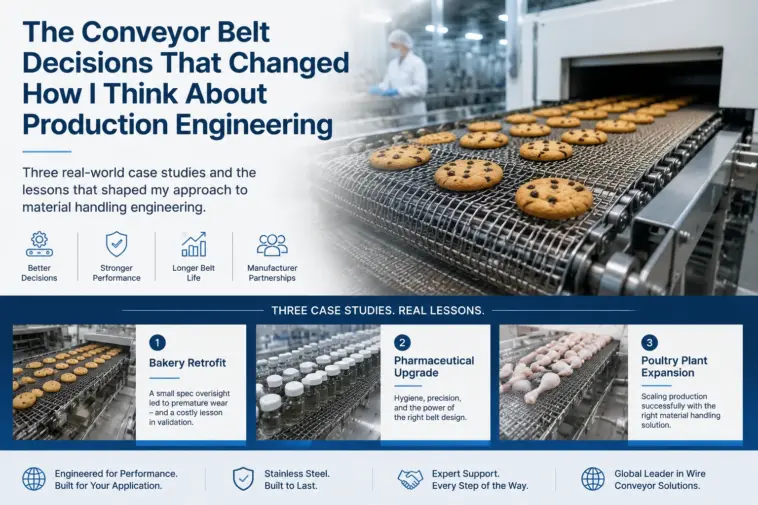
Engineering is a discipline built on lessons. The textbook gives you the principles. Experience gives you the judgment to apply them correctly — and occasionally the humility to recognize when you applied them wrong. Nowhere in production engineering has that been more true for me than in the decisions I have made around wire belt systems and material handling — a discipline that looks straightforward until the consequences of getting it wrong show up on the production floor.
Over two decades of production engineering work, most of my most useful lessons have come from conveyor belt projects. Not because conveyor belts are the most complex engineering challenge in a production environment — they are not. But because they are the asset that sits at the intersection of every other system in the facility. The product. The process. The cleaning protocol. The drive system. The regulatory framework. The maintenance program. Get the belt decision right and everything else runs cleaner. Get it wrong and you are chasing the consequences through every system it touches.
The three case studies I am sharing here are real projects — details changed for confidentiality, but the engineering decisions, the mistakes, and the outcomes are accurate. They represent the moments that changed how I think about wire belt systems and material handling engineering more broadly. And they are the background for why I now approach every belt specification conversation differently than I did when I started my career.
What I can tell you upfront is that the manufacturer relationship matters as much as the specification — something I did not fully appreciate until I experienced the difference between a supplier who shows up at installation and disappears and one who stays engaged through the life of the belt. Wire Belt Company — the worldwide leader in stainless steel conveyor belt and conveyor manufacturing, with over a century of application engineering experience and a genuine global support infrastructure — is the model I use when I explain what that relationship should look like. Their capability across design, manufacturing, installation, custom engineering, technical support, belt surveys, operator training, and maintenance tools is what turns a belt purchase into a production asset. The case studies below explain why I came to that conclusion the hard way.
Case Study 1: The Bakery Retrofit That Taught Me the True Cost of a Wrong Specification
The Setup
The project was a mid-sized commercial bakery — cookies and crackers, two product lines, combined throughput of about 12,000 units per hour. The facility was expanding its second line to match the throughput of the first, and as part of that expansion, both the cooling conveyor and the oven belt were being replaced.
The operations director had been running the first line for eleven years and felt confident about the specification. “Same belt we always use,” was the instruction. “It works fine. Just order the same thing.”
I should have pushed back harder. I did not. We ordered the same belt specification on both systems and moved on to the rest of the project scope.
What Went Wrong
The first line’s belt had been specified for the original oven temperature and the original product mix. In the eleven years since installation, the oven temperature profile had been incrementally adjusted upward — not dramatically, but consistently — to accommodate new product recipes and faster throughput targets. Nobody had updated the belt specification to reflect the operating temperature the belt was actually experiencing.
The belt on the original line was showing its age earlier than it should have — wire fatigue in the high-temperature zone was visibly more advanced than the belt’s age and accumulated hours would predict under the original operating conditions. We had just ordered the same specification for the new line and re-ordered for the original line replacement, replicating a misspecification that had been running unrecognized for years.
The new belts went in. Fourteen months later, the first signs of accelerated wire fatigue appeared in the high-temperature zones on both installations. By eighteen months, we were looking at a replacement timeline that was less than half the service life the specification was supposed to deliver.
The Lesson
The technical cause was straightforward in retrospect: the wire diameter and alloy specification that was appropriate for the original operating temperature was operating outside its optimal range at the elevated temperatures the oven was actually running. A belt survey conducted before the replacement — with the belt manufacturer’s technical team reviewing the existing belt condition against the actual operating parameters — would have identified the misspecification before we replicated it.
What the case study actually taught me was something broader: never inherit a specification without auditing it against current operating conditions. Production parameters drift over time. Belt specifications do not update themselves. The gap between what the specification was designed for and what the belt is actually experiencing accumulates silently until it shows up in premature failure.
The fix: We worked with the belt manufacturer’s application engineering team to re-specify both belts for the actual operating temperature profile — correct wire diameter, correct alloy for the sustained heat exposure, correct pitch for the drive geometry. The replacement belts are now approaching their third year with no signs of the fatigue pattern that appeared at fourteen months on the original specification.
Lesson #1: Audit every specification you inherit before you execute it. The operating conditions that existed when the specification was written and the operating conditions that exist today are frequently not the same. The gap between them is where premature failures originate.
Case Study 2: The Pharmaceutical Packaging Line That Revealed What Technical Support Actually Means
The Setup
A pharmaceutical packaging client — solid dose tablets and capsules, high-volume commercial production — was commissioning a new packaging line that included an inspection conveyor where tablets passed under vision inspection cameras and metal detection equipment before blister packaging.
The belt specification on this line was more consequential than most. The inspection equipment was calibrated to specific product positioning tolerances. Any belt surface irregularity that caused product movement during inspection — vibration, surface texture variation, inconsistent travel — would generate false rejection signals and reduce line efficiency. Any belt surface that caused product to tip or rotate would create orientation errors that the vision system would flag as defects.
The belt manufacturer we initially engaged supplied a standard belt for the application, confirmed it was appropriate for pharmaceutical tablet handling, and moved on. We installed the belt, commissioned the line, and began qualification testing.
What Went Wrong
The false rejection rate during qualification was running at approximately 4.2% — more than twice the acceptable threshold for the line’s OEE targets. Product was moving on the belt surface in ways that the vision system was interpreting as orientation errors and the metal detector was interpreting as positioning anomalies.
The root cause investigation took two weeks. The belt surface texture at the specific pitch we had specified was creating micro-vibration in the product during travel that was within the acceptable range for most applications but was amplifying at the resonant frequency of the inspection conveyor drive system at the target line speed. The combination of belt pitch, drive speed, and belt tension was creating a vibration signature that the product was responding to.
This is the kind of interaction that does not appear in a catalog specification review. It emerges from the specific combination of belt characteristics and system dynamics at actual operating conditions — and identifying it requires an application engineering conversation that goes deeper than confirming the belt can carry tablets without them falling through the mesh.
The Lesson
The belt manufacturer we eventually brought in — one with a technical support model that included application engineering engagement rather than just product fulfillment — identified the interaction in a site visit and proposed a pitch modification that changed the vibration signature at operating speed. We modified the specification, re-installed, and the false rejection rate dropped to 0.6% in the first week of testing with the new belt.
The difference between the two supplier relationships was not the belt technology. Both manufacturers were producing competent products. The difference was the depth of application engineering engagement — one showed up to solve the problem, one had sold us a product and moved on.
Metal conveyor belts in precision applications are not a commodity purchase. They are a system component whose interaction with the specific drive geometry, operating speed, product characteristics, and downstream equipment cannot be fully predicted from a catalog specification. The manufacturer who engages with that system complexity is the one who should be on your approved supplier list for precision applications.
Lesson #2: For any application where the belt interacts with inspection, detection, or precision positioning equipment, the specification conversation must include the belt manufacturer’s application engineering team — not just a product selection from a catalog. The system interaction is where precision applications succeed or fail, and it is not visible in a spec sheet.
Case Study 3: The Poultry Plant Expansion That Made Me a Permanent Convert to Belt Surveys
The Setup
A large-scale poultry processing client was expanding its primary processing line — adding throughput capacity and extending the line to include a new marination and tray-packing station downstream of the existing cut-up operation.
The existing line had been running for seven years on its original belt installation. The belts were stainless steel, the right specification for the application, and visually appeared to be in good condition. The expansion plan called for integrating new belt sections with the existing installation to create a continuous line from the cut-up operation through to tray-packing.
The project engineer on the client side argued for running the existing belts through the expansion and replacing them at the next scheduled maintenance window — eighteen months out. The capital cost of premature belt replacement was a project budget concern, and the belts looked fine.
I had a different instinct. I pushed for a professional belt survey before the expansion went live.
What the Survey Found
The belt survey — conducted by the belt manufacturer’s technical team — found three things that the visual inspection had not.
First, corrosion at wire-to-rod connections in two sections of the existing belt that was not visible on the belt surface but was visible when the survey team examined the belt at transfer points with appropriate lighting. The corrosion was at an early stage but was advancing at a rate that made the eighteen-month timeline to replacement optimistic.
Second, sprocket wear on two of the existing drive assemblies that had changed the engagement geometry enough to be creating stress concentrations at the belt’s rod connections — the same connections where the corrosion was most advanced. The two conditions were interacting: the sprocket wear was concentrating stress at connection points that were already being weakened by corrosion.
Third, a section of the existing belt where the wire tension had been uneven — the result of a tracking adjustment made three years earlier that had never been fully corrected — was showing asymmetric wear that would likely produce an edge failure within twelve to eighteen months under the increased throughput the expansion would impose.
The Decision and the Outcome
We replaced the two belt sections showing advanced wear, replaced the two sprocket assemblies with worn engagement geometry, and corrected the tracking issue that had been producing asymmetric wear. The cost of the survey-driven interventions was approximately 40% of what a reactive failure and emergency replacement would have cost — and that estimate does not include the production downtime cost of an unplanned failure event during the expansion ramp-up period, when a line stoppage would have had maximum operational and customer impact.
The expansion went live on schedule. The belts have now been running for twenty-six months post-expansion with no unplanned maintenance events.
The project engineer who had argued against the survey told me afterward that the finding about the sprocket wear was the one that changed his thinking. “I knew about belt surveys,” he said. “I didn’t know they looked at the drive components.”
That is the answer: a professional wire mesh conveyor belt survey is not a belt inspection. It is a system inspection. The belt, the drive components, the frame, the tracking, the tension — the whole system, assessed by someone who understands how all of those elements interact and what the condition of each one means for the others.
Lesson #3: A belt survey conducted before a significant production change — expansion, throughput increase, new product introduction — is not a precaution. It is standard engineering due diligence. The cost of the survey is always a fraction of the cost of the failure it identifies before it happens.
What These Three Cases Have in Common
Looking across these three projects, the pattern is consistent.
In the bakery case, the failure originated in a specification that had not been updated to reflect changed operating conditions — a gap that a manufacturer engagement before the replacement would have caught.
In the pharmaceutical case, the failure originated in a system interaction that a catalog specification review cannot capture — a gap that only application engineering engagement, with a manufacturer technical team who understood both the belt and the system it was operating in, could identify and resolve.
In the poultry plant case, the failure risk originated in conditions that were invisible to visual inspection — a gap that only a professional survey, conducted by people with the tools and the comparative experience to find what untrained eyes miss, could surface before it produced a failure event.
In every case, the manufacturer relationship was the variable that determined whether the gap was identified and addressed before it cost something, or identified only after it did.
Building the Right Manufacturer Relationship
I want to be specific about what I mean by the right manufacturer relationship, because I have seen too many engineers treat it as a procurement decision — lowest price, fastest delivery, move on — rather than a technical partnership decision.
The manufacturers worth building long-term relationships with are the ones who provide:
Application engineering engagement. Not a catalog. Not a website configurator. A technical conversation with someone who understands the specific dynamics of your application — the product, the process, the drive system, the cleaning protocol, the regulatory environment — and can translate that understanding into a specification that is right for your specific conditions rather than generically appropriate for your application category.
Professional belt surveys. Conducted by qualified technical specialists with the tools and the comparative experience to see what facility maintenance teams, however capable, cannot see. Scheduled proactively as part of the maintenance program rather than reactively after a problem emerges.
Operator training. Not a spec sheet handed to the maintenance team. A structured training program that gives the operators who work with the belt every shift the knowledge to recognize early warning signs and report them before they become failures.
Maintenance tools and resources. Whether physical tools for tension measurement and tracking adjustment, or documentation resources that support systematic inspection programs, the manufacturer who equips your maintenance team is the one who is invested in the performance of the belt across its full service life — not just at the point of sale.
Responsive technical support. When something unexpected happens — and in production environments, something unexpected always eventually happens — the value of a technical support contact who knows your application and picks up the phone is enormous. The manufacturer whose support model ends at the invoice is not a partner. They are a vendor.
The Number That Matters Most
I want to leave you with one number that I now use as the primary metric for evaluating conveyor belt program performance: unplanned downtime events attributable to conveyor belt or drive component failure, measured annually.
Not belt cost per unit. Not replacement frequency. Not survey cost. Unplanned downtime events.
That number captures everything. A belt specified correctly for its application, maintained systematically, supported by a manufacturer with genuine technical engagement, produces a low number. A belt selected on initial cost, maintained reactively, with no manufacturer support, produces a high number — and each event in that number carries a downtime cost that dwarfs the cumulative cost of the maintenance program that would have prevented it.
Track the number. Let it tell you whether your belt program is working. And if it tells you it is not, the place to start is the specification, the maintenance discipline, and the manufacturer relationship — in that order.
The facilities I work with that have gotten all three right have production floors that run the way production floors are supposed to run. That outcome is available to any facility willing to manage its conveyor belt systems like the production assets they are.