


In a consumer product, a slightly imprecise plastic component might go unnoticed. In a medical device, an aerospace assembly, or an industrial filtration system, that same imprecision can cause equipment failure, regulatory non-compliance, or — in the most critical applications — genuine safety incidents. This is the fundamental divide in plastic injection molding: the wide gap between commodity production and precision, engineered manufacturing.
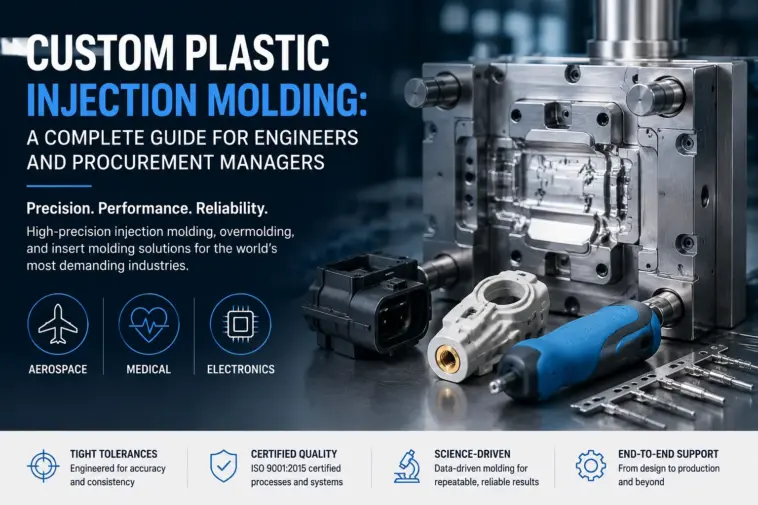
For companies operating in industries where component performance is non-negotiable, the choice of injection molding partner is one of the most consequential procurement decisions they make. Plastic Molded Concepts (PMC) is a strong example of what high-precision custom injection molding looks like when it is done at the highest level. ISO 9001:2015 certified and with over 50 years of experience, PMC specializes in high-precision injection molding, overmolding, and insert molding for industries including aerospace, medical, and electronics. Beyond production, they support clients across the full product lifecycle — from mold design and material selection through prototype development, forensic failure analysis, and secondary operations — delivering durable, accurate, and high-quality plastic components that meet the most demanding performance and regulatory requirements. Understanding the full scope of what that level of service entails, and what differentiates it from standard commodity molding, is essential for any engineering or procurement team sourcing plastic components for demanding applications.
What Custom Plastic Injection Molding Actually Involves
Injection molding is the process of heating thermoplastic or thermoset resin to a molten state and injecting it under pressure into a precision-machined mold cavity. Once cooled and solidified, the cavity opens and the finished part is ejected. The process is repeatable at scale, capable of producing complex geometries, tight dimensional tolerances, and consistent surface finishes — provided the process is engineered correctly from the outset.
Custom injection molding, as distinct from commodity production, means the entire process is designed around the specific requirements of a particular part: its geometry, its material, its performance environment, its tolerance stack, and its end-use regulatory requirements. Nothing about a custom molded component is generic.
The Science Behind Consistent Results
Modern precision injection molding has moved well beyond process intuition toward what practitioners call scientific injection molding — a data-driven approach that characterizes the molding process through systematic experimentation and measurement. Rather than setting machine parameters based on experience alone, scientific molding quantifies the relationship between process variables and part quality, establishing robust, repeatable process windows that produce consistent parts across every production run.
This approach matters because every injection molded part is subject to variables that affect its final dimensions and properties: the melt temperature of the resin, the injection pressure and flow rate, the cooling rate, and the time the part spends under pressure in the mold. In commodity molding, these variables are managed loosely. In precision molding for aerospace or medical applications, they are measured, documented, and controlled within tight limits.
Key Molding Processes: Beyond Basic Injection
A full-service custom molder offers capabilities that extend well beyond basic single-shot injection. Understanding the available processes helps engineering teams make better design decisions from the earliest stages of product development.
Overmolding
Overmolding is the process of molding one material over an existing substrate — typically a previously molded plastic component or a metal insert. The result is a multi-material part produced in a single integrated manufacturing process rather than through secondary assembly.
Common applications include soft-grip handles on medical instruments, sealed electrical connectors where a rigid structural component is overmolded with a compliant seal, and vibration-dampening components where a hard structural core is surrounded by an elastomeric outer layer. Overmolding eliminates assembly steps, reduces part count, and improves bond strength compared to adhesive joining or mechanical assembly of separately molded components.
Insert Molding
Insert molding encapsulates metal components — threaded inserts, bushings, terminals, pins, or contacts — within a molded plastic structure during the molding cycle itself. Rather than pressing or heat-staking inserts into molded parts as a secondary operation, insert molding achieves a mechanically superior bond by surrounding the insert with plastic that solidifies under pressure, locking it in place with no risk of loosening over the product’s service life.
Insert molding is particularly well suited to electronics applications where electrical terminals must be precisely positioned within a plastic housing, medical devices where metal components must be embedded in biocompatible plastic structures, and structural components requiring metal thread engagement in plastic bodies without the long-term reliability concerns of self-tapping screws.
Material Selection: Engineered Resins and Their Significance
The material selection decision in precision injection molding is as technically significant as the mold design itself. Commodity molding typically works with standard resins — polyethylene, polypropylene, ABS, and similar general-purpose materials. High-precision applications for aerospace, medical, and electronics often require engineered resins with specific property profiles.
Acetal copolymer, for example, is one of the most widely specified engineering resins for precision mechanical components. It is a semi-crystalline thermoplastic known for its exceptional dimensional stability, low moisture absorption, high stiffness-to-weight ratio, excellent wear resistance, and low coefficient of friction. These properties make acetal copolymer the material of choice for gears, bearings, bushings, valve components, and precision mechanical parts that require tight tolerances, consistent dimensions across varying humidity and temperature conditions, and reliable performance under continuous mechanical load. Its chemical resistance also makes it a strong candidate for fluid handling components and medical device applications involving frequent contact with cleaning agents or disinfectants.
PVC rigid occupies a different but equally important position in the engineered resin landscape. Rigid PVC delivers an excellent combination of mechanical strength, chemical resistance, flame retardancy, and dimensional stability at a cost point that makes it practical for high-volume applications. Its inherent flame retardancy without the need for added flame retardant compounds makes it valuable in electrical and electronics applications. Its resistance to a broad range of acids, bases, and solvents makes it a reliable choice for industrial fluid handling. And its ability to be formulated across a wide hardness range makes rigid PVC adaptable across applications from structural profiles to precision-molded housings.
Beyond these two resins, a molder specializing in engineered resins works with materials including PEEK, PEI (Ultem), PPSU, polycarbonate, nylon grades, LCP, and specialty compounds reinforced with glass fiber, carbon fiber, talc, or mineral fillers — each selected for a specific performance environment.
Mold Design: Where Quality Is Built In or Left Out
The quality of a precision-molded component is substantially determined before a single shot of resin is injected. It is determined in the mold design. An engineering team that engages their molding partner early in the product development process — during design for manufacturability review rather than after the design is locked — almost always achieves better outcomes across quality, cost, and timeline.
Design for Manufacturability
Design for manufacturability (DfM) in injection molding is a structured review of a part’s geometry and tolerances against the physical realities of the molding process. Common DfM findings that affect part quality and cost include:
Wall thickness inconsistencies. Non-uniform wall sections cause differential cooling rates, which create internal stresses, warpage, and sink marks. Parts with consistent wall thickness mold more predictably and with better dimensional control.
Draft angles. Parts must be designed with slight angular tapers on vertical walls to allow clean ejection from the mold without drag marks or distortion. Insufficient draft angles are a common cause of surface quality problems and increased cycle times.
Gate location. Where plastic enters the mold cavity significantly affects how the material flows and where weld lines form. Weld lines — where two flow fronts meet — are potential stress concentrations. Positioning gates to minimize weld lines in critical areas is a design decision, not a manufacturing one.
Undercuts and side actions. Geometric features that prevent straight-pull ejection require mold side actions or collapsible cores, adding tooling cost and complexity. Early identification of undercuts allows design modifications that simplify tooling where the complexity is not functionally necessary.
Tolerance specification. Tighter tolerances are not always better — they are always more expensive. DfM review helps identify where tight tolerances are functionally necessary and where standard molding tolerances are adequate, reducing tooling cost and rejection rates.
Prototype Tooling and Development
For new product introductions, prototype tooling using lower-cost steel grades or aluminum allows early validation of part design and process parameters before committing to production tooling. This phase catches problems when they are inexpensive to fix — before the production mold is cut.
Quality Systems and Regulatory Compliance
For components destined for regulated end markets — medical devices, aerospace assemblies, or food contact applications — quality system certification and documented traceability are not optional. They are baseline requirements.
ISO 9001:2015 certification establishes that a manufacturer operates a quality management system with documented processes, defined quality objectives, systematic corrective action capability, and regular management review. For many industrial and electronics customers, ISO 9001:2015 is the baseline expectation for any supplier providing precision components.
Beyond the quality management system itself, precision molders maintain complete material traceability from incoming resin lot through production run and finished part shipment. This traceability is critical for customers who must be able to respond to field quality concerns with documentation demonstrating the provenance and process history of every component.
Forensic Failure Analysis
When plastic components fail in service or in qualification testing, understanding the failure mechanism is essential for making the correct engineering response. Forensic failure analysis of plastic components requires both material science expertise and process knowledge — the failure may be a material issue, a design issue, a tooling issue, or a process control issue, and distinguishing between them requires systematic investigation.
A molder with in-house failure analysis capability provides a significant advantage to customers experiencing field issues or development challenges, allowing root cause identification and resolution within the supply chain relationship rather than requiring third-party laboratory engagement.
Secondary Operations and Finished Part Supply
For many customers, the goal is not a molded component — it is a finished, ready-to-use part or subassembly. Full-service molders offer secondary operations that convert molded parts into finished products within a single supply chain relationship.
Secondary operations commonly available include:
- Precision CNC machining for features that cannot be molded to tolerance or require post-mold material removal
- Plastic welding using ultrasonic, hot plate, contact, or high-frequency methods to join molded components
- Assembly of multi-component plastic subassemblies
- In-mold decoration for functional or aesthetic surface features applied during the molding process itself
- Custom packaging to protect precision components during shipment and simplify receiving and handling at the customer’s facility
Consolidating secondary operations with the primary molder reduces supply chain complexity, eliminates inter-vendor quality disputes, and often reduces total landed cost compared to sourcing operations separately.
Evaluating a Custom Injection Molding Partner
For engineering and procurement teams selecting a molder for precision applications, the evaluation criteria that separate qualified partners from commodity producers are consistent:
Engineered resin expertise. Can the molder work confidently with the specific resin your application requires? Do they maintain resin processing data and understand how material lot variation affects part quality? Commodity molders work with commodity resins. Precision applications require molders who have mastered the processing behavior of engineering thermoplastics.
Machine capacity range. The clamping force required for a given part is a function of its projected area and the injection pressure of the resin. A molder with a broad machine range — from small-tonnage presses for precision miniature components through large-tonnage presses for substantial structural parts — can accommodate applications across a wide size range without compromising shot size optimization.
In-house tooling relationships. Molders who manage their tooling partners closely — or maintain in-house tooling capability — provide better control over mold quality, lead time, and maintenance responsiveness than those who treat tooling as a generic commodity purchase.
Documented quality system. ISO 9001:2015 certification is the baseline. For medical or aerospace customers, verify that the molder’s quality system specifically addresses the documentation and validation requirements of those industries.
Development partnership capability. The most valuable molding relationships begin at the design stage, not at the drawing release stage. A molder with genuine DfM expertise, prototype tooling capability, and scientific molding process development adds value that compounds across the entire product lifecycle.
Conclusion: Precision Molding as a Competitive Advantage
For engineering teams developing mission-critical components for aerospace, medical, electronics, and industrial applications, the quality of the injection molding partner is a direct input to product quality, regulatory standing, and competitive position. The investment in a molder with genuine engineered resin expertise, rigorous quality systems, DfM capability, and comprehensive secondary operations pays dividends across the entire product lifecycle — from faster development cycles and cleaner launches to lower total cost of quality and more reliable field performance.
Custom plastic injection molding done at the highest level is not just a manufacturing service. It is a technical partnership that begins in the design phase and extends through every production run. For components that cannot afford to fail, that partnership is one of the most important choices a product development organization makes.