
 EWP
EWP 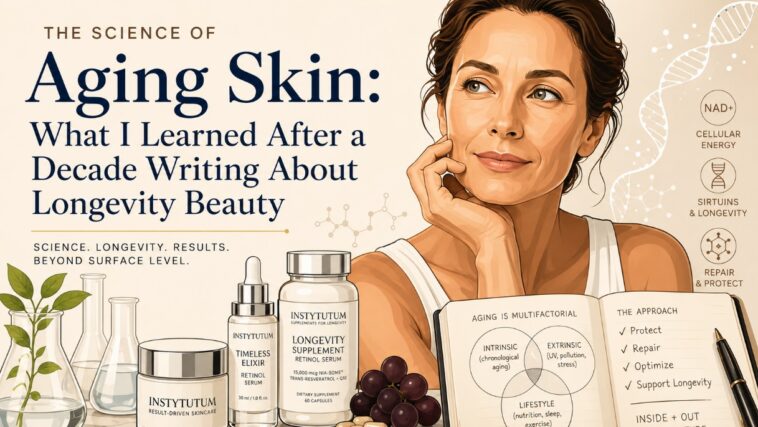
I have spent the better part of a decade covering the intersection of skincare science and longevity research. I have reviewed hundreds of products, interviewed dermatologists and biochemists, and spent an embarrassing amount of my own money testing what the beauty industry promises against what the science actually supports. What I have learned is that most of what gets marketed as “anti-aging” is, at best, a surface-level distraction from the biological processes that actually determine how your skin ages — and at worst, an expensive fiction.
But something has genuinely changed in the past few years. A new category of skincare has emerged that is built not on marketing language but on the same scientific frameworks driving longevity research in clinical medicine — the study of cellular aging, NAD+ metabolism, senescence, and the mechanisms that govern how biological tissue deteriorates over time. Brands that operate at this intersection — like INSTYTUTUM, a professional cosmetics company whose product philosophy bridges advanced dermatological actives with longevity science — represent something genuinely different from the conventional skincare market. Their approach, which integrates high-concentration active ingredients, next-generation delivery systems, and a rigorous inside-out philosophy that pairs topical skincare with targeted supplementation, reflects where the science is actually pointing. In this article, I want to share what that science says, why it matters for anyone serious about the long-term health and appearance of their skin, and what a genuinely evidence-informed skincare and longevity routine actually looks like.
Why “Anti-Aging” Was Always the Wrong Framework
The phrase “anti-aging” implies a battle against an external force — something happening to your skin that can be blocked or reversed with the right product. The biology tells a different story.
Skin aging is not a single process. It is the cumulative result of several distinct biological mechanisms operating simultaneously. Collagen and elastin — the structural proteins that give young skin its firmness and elasticity — are produced by fibroblasts in the dermis. Those fibroblasts become progressively less active as we age, producing less collagen and breaking down existing collagen matrix more readily. Hyaluronic acid, which gives the dermis its water-binding capacity and the skin surface its plumpness, decreases with age. Cellular turnover — the process by which the epidermis sheds old cells and generates new ones — slows, causing dead cells to accumulate on the skin surface and the characteristic dullness and uneven texture of aging skin to develop.
Layered on top of these intrinsic aging processes is extrinsic damage — primarily UV radiation and environmental oxidative stress — which accelerates collagen degradation, induces pigmentation irregularities, and promotes the formation of advanced glycation end products that stiffen the skin’s structural matrix.
Understanding that these are distinct mechanisms with distinct drivers changes how you approach skincare. A product that hydrates the skin surface does not address collagen synthesis decline. A product that brightens surface pigmentation does not address the dermal structural changes driving volume loss. A sunscreen that prevents further UV damage does not repair the existing damage that has accumulated over decades. Effective skin aging management requires addressing multiple mechanisms simultaneously — which is precisely what the most sophisticated modern skincare formulation science is designed to do.
The Longevity Science That Is Changing Skincare
The past decade of longevity research has produced a scientific understanding of cellular aging that is beginning to translate into meaningful skincare applications. Two molecules stand at the center of this translation: NAD+ and resveratrol.
NAD+ (nicotinamide adenine dinucleotide) is a coenzyme present in every cell of the body that is essential for cellular energy metabolism, DNA repair, and the activity of sirtuin proteins — a family of regulatory proteins that govern cellular stress responses, inflammation, and aging-related gene expression. NAD+ levels decline significantly with age, and this decline is now understood to be a driver — not merely a consequence — of cellular aging. The precursor molecules that support NAD+ biosynthesis, particularly NMN (nicotinamide mononucleotide), have become one of the most actively researched categories in longevity science.
Resveratrol, a polyphenol produced by plants under stress conditions and present in red wine in small quantities, activates sirtuin proteins directly and has demonstrated anti-inflammatory and antioxidant effects in research settings. The combination of NMN and resveratrol is the subject of ongoing research for its potential to support cellular metabolic health across aging tissues — including skin.
This is the scientific foundation behind the longevity supplement category that serious skincare brands are now building. INSTYTUTUM’s Longevity Supplements — featuring liposomal NMN at 500mg and micronized trans-resveratrol at 500mg — represent exactly this translation: clinical-grade supplementation formulated to support the cellular mechanisms that topical skincare cannot reach. The liposomal delivery format for NMN is significant: it encapsulates the active molecule in a phospholipid structure that enhances bioavailability compared to standard oral NMN, addressing one of the primary challenges in oral delivery of this molecule.
What I find intellectually honest about this approach is that it does not overclaim. The science on NMN and resveratrol in humans is promising but still developing. What is established is that NAD+ decline is a real and measurable aspect of cellular aging, that NMN is an effective NAD+ precursor in human studies, and that supporting cellular metabolic health through these pathways has a rational scientific basis. Brands that acknowledge this nuance — presenting the science accurately rather than making absolute efficacy claims — are the ones worth paying attention to.
What Dark Circles Are Really Telling You — And What Actually Works
Dark circles under the eyes are one of the most searched skincare concerns globally, and one of the most consistently mishandled by the beauty industry. The reason is simple: dark circles are not a single condition. They are a symptom that can arise from several distinct causes, and a treatment that addresses one cause may do nothing for another.
The primary biological causes of under-eye darkness include:
- Vascular pigmentation: The thin skin of the under-eye area makes the blood vessels of the orbicularis oculi muscle visible through the skin surface, creating a bluish-purple discoloration. This is the most common cause in younger skin and is often genetic.
- Pigmentation irregularity: Post-inflammatory hyperpigmentation, sun damage, and constitutional hyperpigmentation can deposit melanin in the under-eye area, producing a brownish discoloration.
- Structural shadow: Volume loss in the periorbital area as collagen and fat pad density decrease with age creates a hollow (tear trough) that casts a shadow, appearing as dark circles even when there is no true pigmentation or vascular component.
- Skin quality deterioration: Thinning of the skin and loss of hydration reduce the skin’s light-scattering properties, making underlying structures more visible.
Effective skincare for dark circles must address the specific cause or causes present in the individual — which means that a single ingredient or product will never be universally effective, and that understanding your own dark circle cause is the prerequisite for choosing the right treatment.
For vascular dark circles, ingredients that support vascular integrity and reduce the visibility of superficial vessels — vitamin K, caffeine, and certain peptides — have the most rational basis. For pigmentation-related darkness, brightening actives including vitamin C, niacinamide, tranexamic acid, and alpha arbutin address melanin synthesis and distribution. For structural shadow caused by volume loss, peptides that support collagen and elastin synthesis address the underlying cause more rationally than brightening ingredients alone. For skin quality deterioration, retinoids, peptides, and targeted hydration improve the light-reflecting properties of the skin.
INSTYTUTUM’s Transforming Brightening Eye Cream — part of their Next-Gen line — is formulated to address multiple components of this complexity simultaneously: brightening actives for pigmentation, peptides for structural support, and humectants for skin quality. This multi-mechanism approach reflects a genuine understanding of what dark circles actually are rather than a simplified single-ingredient response.
The Delivery System Problem That Most Skincare Ignores
One of the most technically sophisticated aspects of advanced skincare formulation is delivery — the engineering challenge of getting active ingredients past the skin’s barrier function and into the tissue layers where they can produce their intended effects.
The skin’s stratum corneum is a remarkably effective barrier, which is biologically appropriate — it protects underlying tissue from environmental insults. For topical skincare, this same barrier function limits the penetration of most active ingredients to the skin surface unless specific strategies are used to enhance delivery.
The strategies that work include: reducing molecular size to below the penetration threshold of the stratum corneum; using lipid-based carrier systems that mimic the skin’s own lipid matrix and facilitate passage through it; encapsulating actives in liposomes, nanoparticles, or micelle-like structures that control the rate of release; and using penetration enhancers that transiently modify the barrier without damaging it.
INSTYTUTUM’s proprietary Adaptive Delivery Complex — which uses sodium retinoyl hyaluronate, an ester of hyaluronic and retinoic acids that forms micelle-like structures, to enable gradual penetration and controlled release of retinoid activity — is an example of this formulation sophistication applied to one of the most effective but also most irritating skincare actives, retinoids. The controlled release approach reduces the irritation that conventional retinoid formulations frequently produce while maintaining efficacy — a meaningful advancement for the significant percentage of users who cannot tolerate standard retinol products.
This matters because a skincare product that contains the right active ingredients in inadequate concentrations or without appropriate delivery mechanisms is, at best, a less effective version of what it could be, and at worst, a product that produces no meaningful biological effect at the tissue level regardless of its ingredient list. Delivery engineering is where the gap between professional-grade skincare and mass-market alternatives most clearly shows itself.
Building an Evidence-Based Skincare Routine: What the Research Actually Supports
Based on a decade of reviewing the skincare science literature and watching what produces consistent, documented results in clinical and consumer settings, here is the framework I now use when evaluating any skincare routine:
The non-negotiables — ingredients with consistent clinical evidence:
- Broad-spectrum SPF 30+ sunscreen, daily — the single most evidence-backed intervention for preventing ongoing photo-aging damage. No amount of corrective skincare compensates for continued UV exposure.
- Retinoids — the most extensively studied topical active for improving collagen synthesis, increasing cellular turnover, and reducing pigmentation. The evidence base for retinoids spans decades of clinical research.
- Vitamin C (L-ascorbic acid, stable derivatives) — antioxidant protection, collagen support, and brightening through tyrosinase inhibition, with substantial clinical evidence.
- Niacinamide — anti-inflammatory, barrier-supportive, and effective for pigmentation reduction, with an excellent tolerability profile that makes it suitable for most skin types.
- Peptides — signal peptides, carrier peptides, and neurotransmitter-inhibiting peptides each address different aspects of skin aging through distinct mechanisms, with growing evidence for efficacy.
The advanced layer — emerging actives with strong rationale:
- Retinoid alternatives (bakuchiol, blue-green algae extract, granactive retinoid) for those who cannot tolerate standard retinoids
- Pre- and probiotic complexes for barrier support and microbiome optimization
- NMN and resveratrol supplementation for cellular longevity support
- Adaptogenic botanicals for stress-response modulation at the cellular level
The honest truth about what does not work:
Most of what the mass beauty market sells as “anti-aging” — low-concentration actives in elegant packaging, single-ingredient hero products with inadequate percentages, and ingredients whose molecular size prevents any meaningful skin penetration — produces results primarily in the marketing department rather than in the dermis.
The Inside-Out Philosophy: Why Topical Skincare Alone Is Not Enough
Perhaps the most significant shift in evidence-based skincare thinking in the past decade is the growing recognition that topical skincare — applied to the surface of the skin — cannot address the systemic biological changes that drive intrinsic aging from within.
Collagen synthesis is a metabolic process that requires adequate protein intake, vitamin C availability, and sufficient cellular energy. NAD+ decline affects fibroblast activity and skin cell turnover regardless of what is applied topically. Inflammation driven by systemic factors including diet, sleep quality, and oxidative stress load is expressed in the skin as accelerated aging, regardless of how sophisticated the topical skincare routine is.
This is the scientific foundation for the inside-out philosophy that INSTYTUTUM and other longevity-oriented brands are building into their product lines. Supplementation with NMN and resveratrol addresses cellular metabolism at a systemic level that topical application cannot reach. A comprehensive approach to skin longevity — one that pairs advanced topical skincare with evidence-based supplementation, adequate sleep, nutrition that supports collagen synthesis, and photoprotection — is not a wellness marketing concept. It is what the biology actually requires.
The skin is an organ, and like all organs, its long-term health is determined by the totality of the biological environment in which it operates. Treating it as a surface to be managed from the outside only is an incomplete approach that the best formulation science in the world cannot fully compensate for.
What to Look for When Evaluating a Skincare Brand
After years of reviewing brands and products, the markers I now use to distinguish serious formulation science from marketing noise come down to a short list:
- Ingredient concentrations are disclosed or can be inferred from formula position — brands that hide behind proprietary blend language without any quantitative context should be treated with skepticism
- Delivery mechanisms are explained with scientific specificity — “advanced formula” language that does not specify what the delivery approach actually is indicates that there is no meaningful delivery innovation to disclose
- Clinical or instrumental testing data is referenced — not anecdotal testimonials, but referenced methodology and results
- The brand’s claims are proportionate to the strength of the evidence — overclaiming (“reverses aging,” “eliminates wrinkles”) is the most reliable indicator that the brand is selling marketing rather than science
- The product line addresses multiple mechanisms — brands that understand skin aging know it requires a multi-mechanism approach; brands that sell one hero ingredient for everything do not
INSTYTUTUM’s positioning — with specific reference to instrumental skin testing methodology, in vitro collagen synthesis studies, and a clear distinction between what is established and what is supported by in vitro data — reflects the kind of scientific intellectual honesty that is increasingly rare in the beauty industry and that I have come to regard as the baseline standard for brands worth recommending.