 EWP
EWP 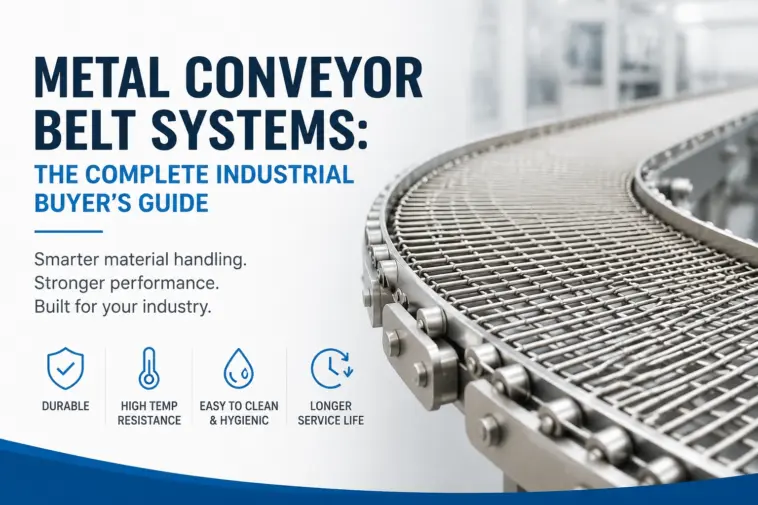
Picture a fully operational food processing line. Baked goods moving through a cooling tunnel. Pharmaceutical tablets passing under inspection cameras. Automotive components advancing through a spray coating station. Electronics traveling through a reflow oven. In every one of these scenarios, the conveyor belt is not background infrastructure — it is the central nervous system of the production process. Its speed, its surface characteristics, its ability to withstand heat, moisture, chemicals, or microbial contamination directly determines what is possible on that production line.
Yet conveyor belt selection and maintenance are frequently treated as afterthoughts — decisions made on initial cost rather than total operational value. That is where significant efficiency and reliability losses originate, and where the right expertise makes a transformative difference. Companies like wire mesh conveyor belt specialists Wire Belt Company — the worldwide leader in stainless steel metal conveyor belt and conveyor manufacturing, with roots dating to 1919 and a global presence across the United States, Europe, and Asia — have built their reputation precisely on the depth of application knowledge, custom engineering capability, and lifetime support that turns a conveyor belt from a commodity component into a competitive advantage. Their expertise spans designing, manufacturing, and installing specialized conveyor belts for food processing and industrial applications, with custom solutions, technical support, belt surveys, operator training, and maintenance tools that extend equipment life, reduce downtime, and optimize performance across every production environment they serve.
This guide explores the full landscape of metal conveyor belt systems — what makes them the right choice for demanding applications, how to select the correct belt type, how to manage performance over time, and what to look for in a manufacturing and support partner.
Why Metal Beats Plastic in Demanding Production Environments
Before exploring specific belt types and applications, it is worth addressing a question that comes up in many material handling discussions: why choose a metal conveyor belt over a plastic modular belt or other alternatives?
The answer comes down to the performance envelope that each material can occupy. Plastic belts are appropriate for many light-duty, ambient-temperature applications. But as application demands increase — in temperature, in chemical exposure, in hygiene requirements, in load, or in precision — metal becomes not just preferable but necessary.
Thermal Performance
Stainless steel wire mesh conveyor belts operate continuously across temperature ranges from deep-freeze cryogenic applications to high-temperature baking and heat treating ovens. This is not a range any plastic material can match. In food processing, this matters because a single belt type can follow a product through freezing, cooking, and cooling stages that would require multiple belt materials otherwise.
Hygiene and Cleanability
Foodborne contamination is an existential risk for food processors. Regulatory agencies including the USDA and FDA impose strict sanitation requirements, and production facilities are subject to audits that evaluate every surface food contacts. Open-weave metal mesh belts offer drainage characteristics, airflow penetration, and cleanability that closed-surface alternatives simply cannot replicate. Their surfaces do not harbor microorganisms in the same way that porous plastic materials can, and they withstand the high-pressure, high-temperature washdown cycles required for HACCP compliance.
Durability and Dimensional Stability
Under sustained production loads, at elevated temperatures, or under mechanical stress, metal wire belts maintain their dimensional stability in ways plastic belts do not. They do not deform, stretch permanently, or lose their structural integrity under the conditions that cause polymer-based materials to creep, fatigue, or fail.
Longevity
When properly specified and maintained, a well-manufactured metal wire mesh belt delivers service life measured in years — often far exceeding the service life of plastic alternatives in comparable applications. The total cost of ownership over the belt’s life frequently favors metal even where the initial acquisition cost is higher.
The Anatomy of a Wire Mesh Conveyor Belt
Understanding how a mesh conveyor belt is constructed helps buyers make more informed decisions about which configuration fits their application.
Wire Diameter
The diameter of the wires forming the mesh directly affects belt strength, open area percentage, and the size of products the belt can support without products falling through or tipping. Heavier wire diameters increase load capacity and belt life. Finer wire diameters increase open area and airflow — valuable in applications where cooling, drainage, or air circulation is a functional requirement.
Mesh Opening Size and Pattern
The geometry of the mesh openings determines what products can be carried, how much airflow or drainage the belt provides, and how the belt surface interacts with the product. Applications processing small food items require tighter mesh to prevent product falling through. Applications requiring maximum air circulation around the product — cooling, drying, or baking — benefit from larger, more open mesh patterns.
Pitch
Belt pitch — the distance between successive connecting rods across the belt width — affects belt flexibility, particularly around the drive and return sprockets. Shorter pitch means greater flexibility and a smoother transition around smaller diameter drive components.
Material and Alloy Specification
Most commercial food processing and pharmaceutical applications specify 304 stainless steel as the standard material. For applications involving higher chloride concentrations, aggressive cleaning chemicals, or saltwater environments, 316 stainless steel offers superior corrosion resistance. Specialty alloys including Inconel and Hastelloy are specified for extreme high-temperature applications in industrial heat treating and furnace environments.
Edge Treatment
Belt edge construction affects tracking behavior, wear resistance, and the belt’s interaction with guide rails. Edge details are often customized based on the specific conveyor configuration and the tension characteristics of the application.
Major Belt Types and Their Application Fit
The wire mesh conveyor belt category encompasses a range of distinct design families, each optimized for specific application requirements. Understanding which design fits which application is the foundation of effective belt selection.
Flat-Flex® Belts
Flat-Flex belts are characterized by their extremely flat, close-weave surface and smooth travel around drive components. Their ability to carry small, fragile, or irregularly shaped products without gaps or surface irregularities makes them a preferred choice in food processing applications including confectionery, bakery, snack foods, and seafood processing.
The flatness of the surface also supports vision inspection systems and X-ray detection equipment used in quality control lines, where any surface irregularity could generate false positives or obscure product defects.
Compact-Grid® Belts
Compact-Grid belts combine high strength with a balanced open area that supports airflow and drainage while maintaining product support across the belt surface. They are widely used in poultry and meat processing, freezing tunnels, and cooking and frying applications where drainage is a functional requirement and hygienic design is non-negotiable.
Their robust construction supports the mechanical stresses and temperature cycling common in high-throughput food production environments.
Eye-Flex® Belts
Eye-Flex belts are designed for applications requiring maximum open area — the highest percentage of belt surface that is open rather than wire. This configuration maximizes airflow around the product, making Eye-Flex an ideal choice for spiral coolers, cooling conveyors, drying tunnels, and applications where heat or moisture transfer between the product and the surrounding air is the primary function of the conveyor.
Versa-Link® Belts
Versa-Link belts use a unique link-type construction that provides high tensile strength and excellent tracking stability in applications where belt tension is significant. They are used in heavy-duty industrial applications, automotive components processing, and applications where the belt operates under high load or where accurate tracking is critical.
Flex-Turn® Conveyor Systems
Beyond the belt itself, conveyor system design significantly affects production layout flexibility and footprint efficiency. Flex-Turn conveyor systems allow product flow to change direction — turning corners — within a production space without the product transfers, elevation changes, or accumulation zones that straight conveyor segments require when direction changes are needed.
For production facilities where floor space is constrained or production flow requires directional changes, Flex-Turn systems can enable production layouts that would not be possible with conventional straight-line conveyor configurations.
Innovation Spotlight: What the Next Generation of Metal Conveyor Systems Looks Like
The conveyor belt industry is not standing still. Several areas of active development are reshaping what metal conveyor systems can do and how they are managed:
Integrated Condition Monitoring
The same industrial IoT trends transforming other areas of manufacturing are arriving in conveyor systems. Embedded sensors monitoring belt tension, temperature distribution, drive component wear, and vibration patterns can provide early warning of developing failures — enabling planned maintenance interventions that prevent unplanned downtime rather than responding to it after the fact.
For production facilities where a conveyor failure stops an entire line, the financial value of predictive rather than reactive maintenance is substantial. A single unplanned production stoppage in a high-volume food processing facility can represent tens of thousands of dollars in lost throughput, waste product, and labor cost.
Hygienic Design Evolution
Regulatory pressure on food production hygiene standards continues to intensify globally. Belt and conveyor system designs are evolving in response — reducing the number of joints, connections, and surface features where food residue can accumulate, improving drainage characteristics to prevent moisture pooling, and enabling faster, more complete cleandown cycles that reduce sanitation time and water consumption.
Manufacturers at the forefront of this trend are not simply meeting current standards — they are anticipating the direction of regulation and designing systems that will remain compliant through future regulatory evolution.
Sustainable Materials and Manufacturing
The industrial manufacturing sector faces increasing pressure to reduce energy consumption and environmental impact. In conveyor belt manufacturing, this is manifesting in the development of lighter-weight belt designs that reduce drive power requirements without sacrificing performance, extended service life engineering that reduces material replacement frequency, and manufacturing process improvements that reduce energy and material waste.
For production facilities with sustainability mandates — increasingly common in global food and pharmaceutical supply chains — the environmental profile of their equipment suppliers is becoming a procurement consideration alongside price and performance.
Modular System Architecture
Traditional conveyor systems require significant reconfiguration when production layouts change. Modular conveyor architectures — where standardized components can be rapidly reconfigured into different layouts — are reducing the capital cost and time required for production line changes, supporting the operational agility that modern manufacturing environments increasingly demand.
The Hidden Cost Driver: Unplanned Downtime
For any production environment operating metal conveyor systems, unplanned downtime is the enemy. The direct cost of a production stoppage — lost throughput, labor standing idle, potential product waste — is visible. The indirect costs — schedule pressure on downstream orders, customer service impacts, maintenance overtime — are less visible but equally real.
Most unplanned conveyor downtime is preventable. It originates in predictable failure modes that a structured maintenance program identifies and addresses before they cause line stoppages.
The Most Common Failure Modes
Belt fatigue and wire breakage. Wire breakage in a mesh belt typically begins at stress concentration points — particularly around drive sprocket engagement zones where bending stress is highest. Early-stage wire breakage is detectable through visual inspection before it propagates to belt failure.
Tracking problems. A belt that drifts off center wears against guide rails, stresses the belt edges, and can eventually cause catastrophic belt failure or jam the conveyor mechanism. Tracking problems originate in misaligned drive components, uneven belt tension, or belt damage — all correctable if caught early.
Drive component wear. Sprockets and drive shafts wear through normal operation. As wear progresses, the engagement between drive components and the belt changes, increasing stress on the belt. Monitoring drive component wear and replacing components on schedule prevents the accelerated belt wear that worn drive components cause.
Corrosion. Even stainless steel is susceptible to corrosion under the right conditions — particularly in chloride-rich environments or where incorrect cleaning chemicals are used. Early-stage corrosion affects wire integrity before it becomes visible to casual inspection.
Building a Metal Conveyor Belt Maintenance Program
A structured maintenance program is the most cost-effective tool available for maximizing conveyor belt service life and minimizing unplanned downtime. The investment in systematic maintenance consistently returns multiples of its cost in avoided failure events and extended belt life.
Belt Surveys: The Professional Assessment
A professional belt survey — conducted by an experienced conveyor specialist who inspects the belt, drive components, conveyor frame, and overall system condition — provides an objective baseline assessment and identifies specific issues requiring attention.
Wire Belt Company’s belt survey service is an example of the value a specialist partner brings beyond the initial sale. Their technicians bring the application knowledge and comparative experience to identify issues that in-house maintenance teams, who typically see only their own systems, may not recognize as developing problems.
Surveys are most valuable when conducted on a defined schedule — annually at minimum for high-utilization belts, more frequently for belts operating in aggressive conditions.
Establishing Inspection Intervals
Between formal surveys, a structured internal inspection program maintains visibility into belt condition. Inspection intervals should be calibrated to the utilization rate and operating conditions of the specific belt:
- High-utilization belts (24/7 operation, aggressive temperatures or chemicals): monthly visual inspection, quarterly detailed inspection
- Standard-utilization belts (single or double shift, moderate conditions): quarterly visual inspection, annual detailed inspection
- Lower-utilization belts: semi-annual inspection aligned with production schedule
Inspection records should be maintained systematically, enabling trend identification over time. A belt that has required two spot repairs in six months is communicating that a more comprehensive assessment is warranted.
Operator Training
Operators who understand what a healthy belt looks like — and who are trained to recognize and report early warning signs — provide the most timely possible detection of developing issues. Training investment is modest compared to the downtime cost of failures that trained operators would have caught early.
Key areas for operator training include: normal vs. abnormal belt appearance and behavior, correct reporting procedures when anomalies are observed, proper belt cleaning procedures that avoid chemical or mechanical damage, and load placement practices that avoid edge loading or point loads that stress the belt beyond its design envelope.
Selecting a Metal Conveyor Belt Supplier: What Actually Matters
When evaluating suppliers for a wire conveyor belt purchase or system installation, the selection criteria that correlate most strongly with long-term satisfaction extend well beyond unit price.
Application Engineering Depth
The supplier’s ability to translate your specific application requirements — product characteristics, production environment, speed, temperature, cleaning protocols, regulatory constraints — into an accurate belt specification is the most important capability they bring. A supplier who defaults to a standard catalog recommendation without understanding the application is setting the customer up for underperformance or premature failure.
Request evidence of experience in your specific industry and application type. References from comparable installations carry more weight than general capability claims.
Custom Manufacturing Capability
Standard catalog belt widths and lengths fit many applications. Specialized production environments frequently require custom configurations — non-standard widths, specific edge treatments, custom mesh geometries, or integrated components that a belt manufacturer without in-house custom fabrication capability cannot produce. Confirm that the supplier can manufacture to your specific dimensional and performance requirements, not just supply from a standard product range.
Global Support Infrastructure
For multinational production operations, a supplier with consistent global service capability — the same belt specifications, application expertise, and support quality available across all production locations — eliminates the complexity of managing multiple regional suppliers with different products, specifications, and support models.
Wire Belt Company’s presence across the United States, United Kingdom, Germany, France, China, Sweden, and Italy reflects the kind of global infrastructure that multinational production operations require.
Responsive Technical Support
Production problems do not schedule themselves around business hours. When a conveyor belt issue threatens to stop a production line, the supplier’s ability to respond quickly — with knowledgeable technical guidance, not just a ticket number — is operationally critical. Evaluate the supplier’s technical support model before you need it: response time commitments, technical expertise of support staff, and parts availability for urgent situations.
ROI Framework: Calculating the True Value of Belt Selection
When evaluating competing belt options, a total cost of ownership framework produces a more accurate comparison than purchase price alone.
Variables to Include in the Calculation
Belt acquisition cost: The purchase price of the belt, including any custom fabrication premium.
Installation labor: The time required to install the belt, including any downtime cost associated with the installation window.
Expected service life: Based on the manufacturer’s application-specific service life data, adjusted for your specific operating conditions. A belt with higher initial cost but double the service life of a cheaper alternative may be significantly lower cost per production hour.
Maintenance cost: The labor and material cost of the maintenance program required to achieve the expected service life, including inspection, repair, and drive component replacement.
Downtime cost per event: The total cost of a production stoppage caused by belt failure, including lost throughput, labor, and any product waste. Multiply by the expected failure frequency to annualize.
Energy cost: Belt mass and drive resistance affect the power required to operate the conveyor. Lighter or lower-friction belt designs can produce measurable energy savings over the belt’s life.
Cleaning cost: Belt designs that clean faster or require less water and chemical usage reduce the operational cost of sanitation programs — a meaningful variable in food processing environments where daily sanitation is required.
Running this framework consistently across belt options — rather than comparing only purchase price — reveals the true economic value of belt quality and supplier support capability.
Conclusion: The Conveyor Belt as a Strategic Production Asset
The most effective industrial and food processing operations treat their metal conveyor belt systems as strategic production assets rather than maintenance liabilities. They invest in correct initial specification, they implement structured maintenance programs, they partner with suppliers who bring genuine application expertise, and they evaluate belt performance on total operational value rather than purchase price.
The result is production lines that run longer between unplanned stoppages, that meet hygiene and regulatory standards consistently, that consume less energy and maintenance labor over time, and that provide the operational reliability that customers and supply chain partners depend on.
For operations ready to move from reactive conveyor management to strategic asset management, the starting point is the same: find a supplier with the application knowledge, manufacturing capability, and support infrastructure to be a genuine partner — not just a vendor — across the full life of the belt and the production environment it serves.